Rig Rundown - Guitars - (see introduction here)

Several months ago I started a series on the guitar rig and playing techniques of the late, fantastic John Cipollina. This instalment will touch on Cipollina's amps and effects, you can read the first chapter, which focuses on his choice of guitars, here.
Amps: The amp set up Cipollina implemented was an integral part of his signature sound, and can be seen as driving force in solidifying the psychedelic sound of the San Francisco music scene of the 1960's.
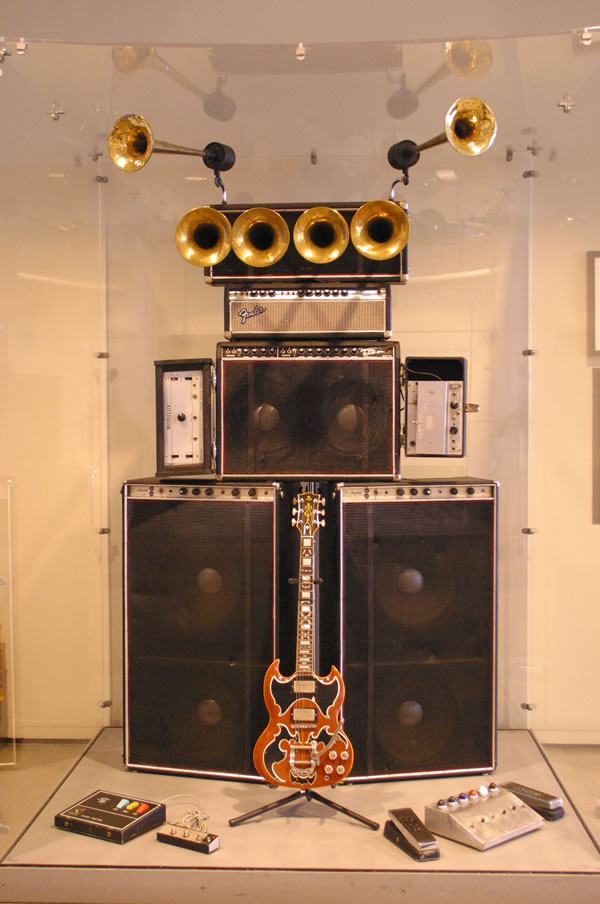
Cipollina's unusual selection and combination of amps resulted in an entirely unique amp stack. On the bottom of the stack sat two solid-state Standel bass amps, each of which were equipped with two 15 inch speakers. In contrast, on the top of the stack sat two Fender tube amps: a Twin Reverb sporting two 12-inch speakers, and a Dual Showman which had been modified to drive six Wurlitzer horns.
As previously mentioned in chapter one, this set up was deliberately designed so as to form a symbiotic relationship with the guitar. Cipollina's SGs were wired to have one pickup going purely to the Standel bass amps, and have the other pickup going purely to the Fender guitar amps. This meant Cipollina could play with the low crunch of the Standel amps and the classic spiky cleans of the Fenders simultaneously.
"I like the rapid punch of solid-state for the bottom, and the rodent-gnawing distortion of the tubes on top" - John Cipollina
Lastly, Cipollina also used the driven Wurlitzer horns to good effect, using a foot-switch to turn them on and off. When pushed by the Dual Showman, they provided a familiar rounded tone with overtones of distorted tube breakup (An example of the horn tone can be heard in Quicksilver Messenger Service's 'How You Love').
Effects: Moving onto the last element of Cipollina's famously extraordinary rig, we come to his effects. Although much of Cipollina's sound was provided courtesy of his eclectic amp selection, some of his tone was derived from effects pedals and units.
Most notably, Cipollina's Twin Reverb sported two tape echo machines, one fixed to either side. On the left clung a Standel Modulux, and in similar fashion, so did a Astro Echoplex on the right (scroll down to bottom for image of stack). Like the horns, operation of these was controlled by foot-switch. Quicksilver Messenger Service's 'Mona' provides a perfect example of these echo machines in use.
Alongside these units, Cipollina also used several Vox wah pedals, which he often used to modulate his guitar signal when using his tape-echo's (once again, hear 'Mona'). For a fuzz, a Gibson Maestro was used (the same pedal used by The Rolling Stones on 'Satisfaction' and by The Doors on 'Hello, I Love You'). Volume pedals were also used when a song called for less distortion for example.