
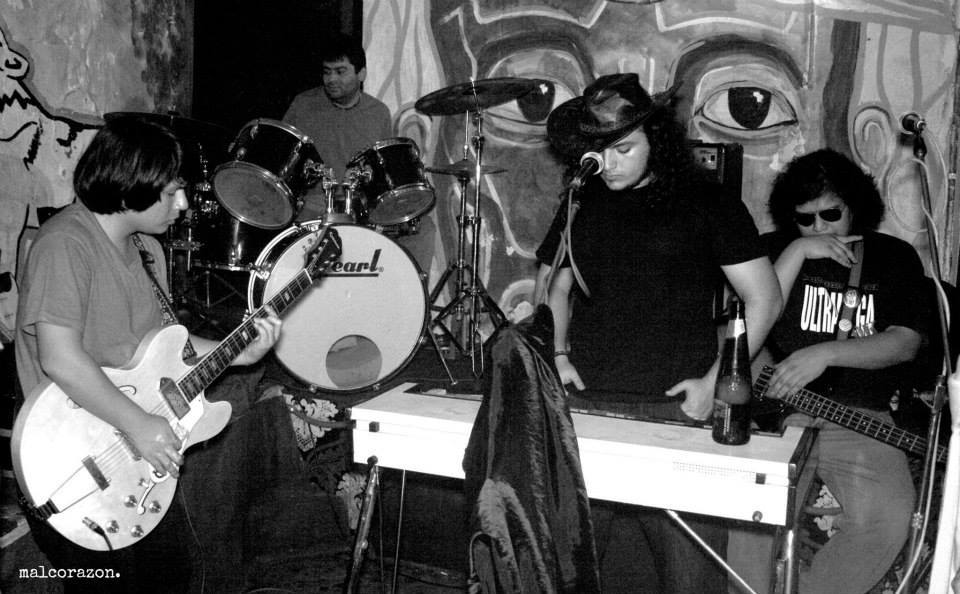
43 years ago listeners from across the globe took the needle off of their copies of L.A Woman, left with nothing but the harrowing vocal refrain of Jim Morrison singing 'Riders on the Storm'. Over four decades later, Peru-based psychedelists, The Dead-End Alley Band, are bringing it all back. Taking inspiration from the past, this group are creating some of the most authentic-sounding blues-based, stoner rock to come out of the South American continent in recent times. Enjoy the latest instalment in our continuing series of interviews out of Lima, Peru. (read instalments one + two). - Interview conducted by Daniel Sharman.
Dan: Who is in the band, and who plays what?
Sebastian: Hi, Daniel. Well, this psychedelic adventure
started with Javier Kou, playing guitars, bass and some vocal, and me,
Sebastian Sanchez-Botta, playing vocals, organs, piano and some drums. Then, on
the road, we added a couple of friends to perform live. They are Leonardo Alva
on lead guitars, and Jaime Diaz on drums, so, the final line up is: Me on
vocals and organs, Javier on vocals and bass, Leonardo on guitars, and Jaime on
drums.
Dan: Where does the name The Dead-End Alley Band
originate from?
Javier: Besides psychedelic music, I like some other
genres and bands, so the name came up a long time ago between 2006 and 2007
when I was listening to Enrique Bunbury’s new album (in that time) in
collaboration with another Spanish singer named Nacho Vegas. One of the songs
of the album was ‘Welcome to El Callejón sin Salida’ and I liked the part of
‘Callejón sin Salida’ that in English is ‘Dead-End Alley’, so I just put the
‘The’ at the beginning and the ‘Band’ at the end and that was it: The Dead-End
Alley Band. I saved that name for some years till I told Sebastian to start
this project.

Dan: Some of the Dead-End Alley Band's songs are
very organ-focused, not all too common in the often guitar-dominated world of neo psychedelia. What caused you to bring organ into the mix?
Sebastian: It’s because, our first influence to start
making psychedelia were ‘The Doors’. Their music had a lot of Ray Manzarek’s
organs presence, so we started loving that kind of mix between laced-cheesy-obscured
organs with some delayed and fuzzy blues guitars.
Javier: Yeah, and also, in my opinion, the organ
plays such a big role in the music we create, is like the nexus between the
real world and the trip we offer.
Dan: Your sound contains a wide variety of band's, such as The
Doors, The Deltones, Country Joe and The Fish, etc. What are some of your
influences, and current favourite bands?
Javier: For the band, some other influences besides
the ones you already mentioned are ‘Iron Butterfly’, ‘Phantom’s Divine Comedy’
and maybe some of ‘Vanilla Fudge’. Also when I have to create bass lines some
of the influences are from Deep Purple’s Roger Glover and Black Sabbath’s
Geezer Buttler. And talking about favourite bands, if I have to
name 5 I would say: ‘The Doors’, ‘Alice in Chains’ (the old one without the new
vocalist), ‘Alice Cooper’, ‘Héroes del Silencio’, and ‘Judas Priest’.
Sebastian: And for me, my personal influences in organs
comes, besides Ray Manzarek, from classical music, some goth organs from Tim
Burton’s movies, for example, or some sixties horror b-movies.

Dan: I notice that Javier Kou plays both guitar and
bass on the records, how does this work in a live context?
Javier: Like Sebastian said, we had to add some people
to play live, so, I play bass at the concerts, because Leonardo is so much better
guitarist that I am.
Dan: Why was Leonardo Alva brought into play lead on
the track 'The Cosmic Cry Out'?
Sebastian: When we included Leo in the band, we found
that he is a blues man. He had a very sweet and sexy “hendrixian” way to seduce
with his guitar. ‘The Cosmic Cry Out’ it supposed to be a very sensual track,
so… the man with sensual bluesy solos must be there.

Dan: I feel like I'm interviewing a tonne of bands
from Lima recently! First Montibus Communitas, then Spatial Moods, and now you
guys! How do you feel about the Lima musical scene?
Sebastian: I have a personal feeling about Peruvian’s
rock and music as well. I think that the most representative sound of Peruvian
rock is the psychedelia from Traffic Sound, Laghonia, Los York’s, etc. Then,
combined with the popular ‘chicha’ (psychedelic cumbia), it seems to be that
psychedelic sounds are representative from this country. Is not weird, at the
end of the day, to find out that we are living in a psych rock camp. A lot of
bands here love having a psych sound in their style, and finally you realize
that psychedelia is good looking outside, but in Lima, it lives in a very
underground world.
Dan: What guitars were used on the Odd Stories
recording sessions?
Javier: I like the question, man! Hahaha, Ok!, we
used 3 different guitars, a Thomas guitar (A vintage Japanese copy of a Mosrite
guitar), an Ephiphone Hollow Casino and 1968 Univox, provided by our friend,
brother and co-producer, Chino Burga (from La Ira de Dios).

Dan: Also, what organs/keyboards were used on the
album?
Sebastian: Since we started playing and recording, I
play with a Farfisa Fast 5 organ, from 1969.
Dan: How about amps and effects (for both organ and
guitars)?
Javier: Vox pathfinder and Marshall.

Dan: In a more general sense, what were the Odd
Stories recording sessions like? Why did you decide to overdub the sound of
rain onto tracks like 'Blue at a distance'?
Sebastian: We
used to record in our home studio. Also, we record some tracks in some friend’s
houses or studios. For example, drums were edited and mixed at Jaime Diaz
studio. ‘Blue At Distance’ is a track with some feelings of loneliness. The
story of a lonely guy walking through the streets at night, under the rain. We
thought the sound of rain could increase that feeling of loneliness we wanted.
Dan: Who created the artwork of Odd Stories? And
what does it depict?
Javier: Sebastian came with the whole illustration,
and I made the work in photoshop.
Sebastian: It's an "odd story" too,
hehe. The first song we composed for this album was Devil's Mask. It was my
favorite song, and also, I told Javier to have that song as a single for the
album. I thought the album will be called 'Devil's Mask', so I draw this weird
guy with a 'diablada' mask, representative from the southern highlands here.
When I wrote the lyrics and thought the story of the song, I decided to use
that mask, because it's very crazy. It looks very mad and psych, too.

Dan: What's next for The Dead-End Alley Band?
Javier: Actually we are working in some demo's for
the 3rd album, I guess we have the songs we want to record in a
close future, but I would like to have more songs so we can choose some of them
and save the others for b-sides or compilations with other bands. That’s all I
can say about.
Dan: Is their anything else you would like to say or any shout-outs you would like to make?
Javier: Hmm, not really, we are preparing the
official release of the LP here in Lima, also some labels here are working now
on the CD and Tape editions of the ‘Odd Stories’ so it will be a complete album
release, a big party (or slaughter… hehehe)! Also we would like to thank to all
the people who have been supporting us since the beginning, I won’t say names ‘cuz
it may take too long, and thank you for the interview and the time.
Sebastian: Just hit “play” and let yourself get carried
away by a night of pure madness!!
Check out the fantastic new Dead-End Alley Band record, Odd Stories, here.
Also, make sure to like the band's Facebook page to keep up to date, here.

