Showing posts with label fuzz. Show all posts

Monday, 22 September 2014

Social End Products: Nutre Tu Cabeza Review

Hard-hitting spook-psych from the heart of Greece, Social End Products return with a strong début LP after their 2011 EP-release, Ego Trip. - Review written by Daniel Sharman.

Released in: 2 May 2013
Genre: Garage-Surf Psychedelia/Acid Punk
Record Label: Radar Eye Records
Medium: Digital download, Vinyl LP
Recorded at: Feedback Studios

Recently, I was fortunate to be sent vinyl copies of both of Social End Products' record releases, Nutre Tu Cabeza and Ego Trip. After giving Nutre Tu Cabeza several listens, I thought I would share my thought's on the record for the whole world to see, and to try and give this record the love it deserves!

The whole of Nutre Tu Cabeza has a consistently relaxed-but-taught vibe, striking the perfect balance between the sinister edge of classic, spooky psychedelia and upbeat, far-out funk trippery. Boasting a track listing of 14 songs, Nutre Tu Cabeza clocks in at around 30 minutes, each song being a short psychedelic burst of about 2:30 minutes.

The LP makes good use of its combination of a large number of tracks and short song durations, demonstrating the band's ability to express different musical nuances within their own developed sound. Throughout the record you can hear influences form genres such as garage, surf, psychedelic rock, acid punk, folk, country, and more. 

Sonically-speaking, Jangling Vox guitar rhythms and blown-out fuzz leads litter the landscape of each track, giving Social End Products a distinctly...European-psych sound. It is this mix of garage, low-fidelity instrumentation with a sheer love of, and conviction, in what they are preforming that gives European bands like the Social End Products an authenticity that I think can sometimes be lacking in contemporary American psychedelia. 

Each track deals most typically in acidic and sombre lyrical territories: deserts, strangeness, women, ect. Like most garage rock, this lack of lyrical innovation actually adds to the listening experience, as the experience in and of itself is made much easier to digest and get engaged with thanks to this aforementioned simplicity. This ease of engagement is also certainly aided by the groovy basslines which thump through the tracks, and the high-octane drum beats which pulse behind most of the tracks (providing the previously-mentioned half- upbeat skew of the record). 

Tracks like 'I'm Strange' and 'Slit Your Wrist' take the listener in one direction with slicing reverberated leads, but then change direction when the basslines and backing rhythm guitars elevate the tracks onto other levels of energy that can't help but make you tap your foot and shake your head in time to the groove and beat. Tracks like 'Wrong Side of the Track' change pace a little, but still remain with the ballpark of the rest of Social End Products work. 

Furthermore, throughout Nutre Tu Cabeza you can hear the influence of surf greats like Dick Dale, The Ventures, and Link Wray; garage legends like The Seeds, and (early) Jefferson Airplane; and many other classically far-out sources such as 1970's psych-prog rock, ect. That is to say, if you like any of the bands I just mentioned, this could be a damn solid record for you.

Critic's Comment: The main success of this album is its ability to lock into that metaphysical 'groove', which is so often associated with psychedelia, and stay with it for damn near 14 short-but-sweet tracks. If you find yourself at an ends this week, or weekend, whilst searching for a record to put on as you drink your coffee, I highly recommend Nutre Tu Cabeza to aid in your invigoration. Heck, if you can, buy the damn vinyl - it's just one of those listens that demands the physical medium.

Find the album here for download AND vinyl purchase here.

Make sure to like the band's Facebook page here, as I am led to believe they are soon to have new recordings being released...

Sunday, 14 September 2014

The Night Collectors: Voice of the Cicada (Single Review)

Released in: 1 May 2014
Genre: Desert Rock/Wilderness Rock
Record Label: Self-release
Medium: Digital download, Cassette
Recorded at: Unknown

Voice of the Cicada was Do You Even Psychedelic?'s single of the month a while back, and with good reason too. I've pretty much played this record to death, and I'm still not bored of it. Spanning a whole cassette, Voice of the Cicada was released as a sort of LP in its own right, and currently holds a considerable amount of my cerebral focus.

Spanning 15:11, Voice of the Cicada is a hearty offering of raw desert instrumentation, born from the dusty plains of the Arizonan Sunbelt. Lead guitarist, Connor Gallagher, delivers a piercing guitar performance, laden with gingerly chosen delay, fuzz, etc. immediately giving structure to the thudding, tribal beat of the percussion section. Greasy, wild saxophone also accompanies the guitar work, giving a free jazz element to the tracks persona, and evoking the work of fellow Tuscon-based band, the Myrrors (see Romana Parra). The bass work is heavy, and creates an up-and-down, waving beat which the percussion section hazily follows. From this symbiotic energy which the bass and drums create comes a fusillade of drones and chants, some reminiscent of tribal expression, and some evocative of the eponymous Cicada's voice.

As the track progresses, the tempo of the song gradually increases, and so does the instrumentation with it. The guitar sections become more overdriven, starting to align themselves more and more with the aforementioned Cicada. Wailing vibrato bends litter the crescendo beat at 7:00, conjuring up imagery of the savage desert winds, and transforming the song's structural being into a sonic lather. 

This energy keeps building, increasing the tension of the song, and the guitar section becomes more and more violent (pure bliss for anyone who is really looking to dig an effects-soaked guitar played well tastefully for a change). The beat dissipates, and the track slows down, at around 10:00. It is at this point we hear a recording of an actual cicada, closing the song in genuine dust-driven noise. A genuine reminder of the power of vibrations.  

The track is currently up for 'Name Your Price' on Bandcamp, so make sure to head over and get a copy now, and support these guys. Link here. The band also keeps home-made cassette copies of the song, so if you are ever available to hit up one of their gigs..make sure you do! (Facebook page with all events on here).

It also worth mentioning that the band recently did a live recording for radio of the song, which is a slightly different version, so if you are hardcore, check it out here. 

Review written by Daniel Sharman.

Friday, 12 September 2014

The Dunes Interview with Adam Vanderwerf!!!

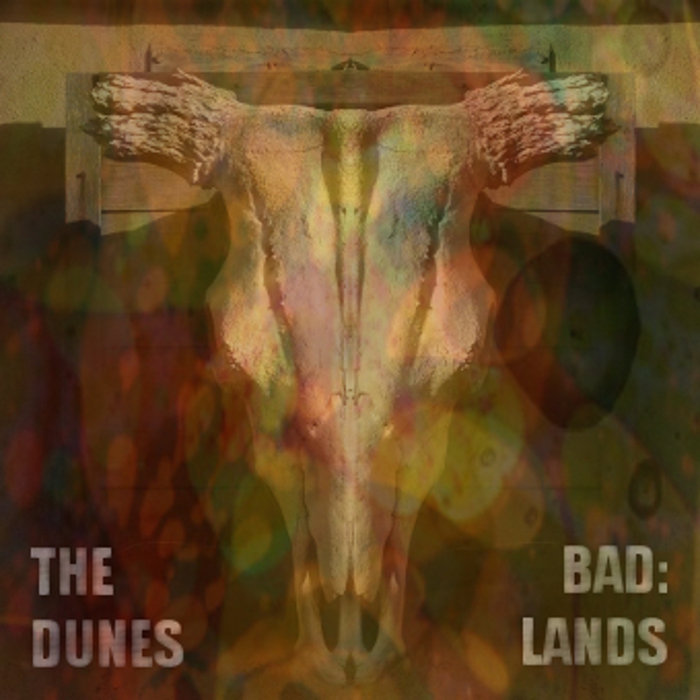
Ever wondered what it would feel like to look in the other end of the telescope? Well, wonder no more as we question the soft-rock atmospherists, The Dunes. Their 2013 release, La Musique Nouveau, demonstrated the band's amazing handle on depth, and space. Very recently The Dunes released BAD:LANDS, showing the darker side of the band's talent, and expressing the compendium of psychedelic treats this band still has to offer - (Interview conducted by Daniel Sharman).

Dan: Where do you guys hail from, and who is in the band?

Adam: Stacie Reeves – VOX & percussion
Matt Reiner – Guitar
Adam Vanderwerf – Bass / Synths
Jess Honeychurch – Organ/Synth
Dan Fernie-Harper – Drums / percussion

The Dunes are based in Adelaide, Australia.  We have all been in bands over the years, and fairly involved in the music scene here at home.

Dan: Where do The Dunes get their name from (with addendum to band history)?


Adam: The Dunes was originally conceived as a 2-piece by Matt Reiner. The name came to him in a dream.  After the first EP (Going Under) was released, Dan and I (Adam) joined the band, followed by Jess. It’s a great dynamic in the band now. Originally the songs were mainly written by Matt Reiner, but with our upcoming releases, we have all worked together to come up with new material – I think that people will be surprised with what we are writing now; it’s a departure from some of the old stuff, but still keeping that “Dunes” sound.


Dan: The band has a wonderful, airy space rock atmosphere - Who are some of your influences?

Adam: We have a lot of influences, but ones that have been helping lately are Black Mountain, Moon Duo/Wooden Shjips (read out interview here), Elephant Stone, The Cult of Dom Keller, The Black Angels, Dead Skeletons, and more.

Dan: How do you go about writing for The Dunes?

Adam: As mentioned before, Matt Reiner would often come to practice with most of a song already arranged and written, and the rest of the band would come up with their parts. With the new stuff we have just been locking ourselves in our practice space and recording our jams. With our new track Badlands I had recently purchased a Korg Monotribe and had been playing around with the settings and sounds. After a few jams we had worked out the track and figured out how to play it live. The other new track “End Of The Beginning” basically came from the main riff that Matt Reiner came up with during a jam some time ago. It was too good to let go so we wrote the song around it.


Dan: The Dunes are often posting pictures of their fantastic gear on Facebook, and suchlike. What were some of the guitars used on La Musique Nouveau?

Adam: We are all gear nerds when it comes down to it. On LMN Matt used a Fender Strat and a Mini Maton acoustic. I had just picked up a early 90s Fender P Bass and swapped out the pickups to Seymour Duncan Antiquity II’s. Amazing tone. On the new tracks we are using a Vox Teardrop for guitar and ive recently picked up a ’78 Fender P-bass. The ’78 P has now become my workhorse – there is something about vintage gear that makes it feel and sound better in my opinion.  Most of the guitars are in standard tuning, whilst my bass is tuned down 2 steps. I also prefer using heavier gauge strings (50-115 GHS Boomers).

Dan: And how about amps, and effects?

Adam: Amp wise, for the guitar we used a Fender Princeton and Bass was a Fender bandmaster with Ampeg Classic 4x10. The latest one I used a Fender Bassman 100 head. Effects are a beast, but to give an example of some that we are using: 

Boss DM2 Delay (also used for vocals)

EHX 45000 looper

Strymon Timeline
EHX cathedral (vocals)
Russian Big Muff
EHX Double Muff 
Boss TR2 Tremelo
EHX Pulsar
Tyms Big Bottom
Malekko B:Assmaster
EHX Bass Big Muff
Fairfield Circuitry Unpleasant Surprise
EHX Holy Grail

There are a heap more, but those are the ones that come to mind at the moment. We are always looking for new sounds, and experimenting with pedals/effects. Another pedal that I’ve just ordered is the Elephant Stone Bass Fuzz. We are big fans of Elephant Stone and were pumped to see they released some signature fuzz pedals.


Got Fuzz?

Dan: How about any additional instruments?

Adam: Our keys player uses one of 2 organs – A Baleani 2 tier combo organ that we found in hard rubbish years ago. Works perfectly and easy to transport live. When recording we used a Hammond organ, and also a Yamaha YC25D. We also throw in a Korg MS10 synth when we play live. As I mentioned before, we have been playing around using a Korg Monotribe for some trippy effects, as well as a few noise pedals in loop – that will be coming out more in a live setting later down the track. Also when we play live we use a electronic Shruti Box for that drone tone.

Dan: The Dunes preference of space and ambience over hard hitting instrumentation is a real fresh of breath air in many ways. Was there a conscious effort to keep the songs deliberately clean and relaxed?

Adam: Exploring the idea that music can take you on a journey is always something that I look for when making new music. I think with La Musique Nouveau the theme of space and ambience works perfectly in the context of the EP – the most ‘rockiest’ of the songs was “A Thousand Crimes” I think as you play together as a band you start to hear the songs in a different way which allows you to experiment more and add extended jams to parts, rewrite passages and put something new to the songs. If you want to hear the song note for note, buy the CD, sit at home and listen to it; I think in a live setting the idea of extending songs and improvising bits gives the audience more. I'm a big fan of putting on a “Show” rather than just standing on stage playing the songs start to finish. When possible we try to incorporate visuals into our set as much as possible.


Dan: What is next for The Dunes?

Adam: We have just released a double single BAD:LANDS featuring the tracks Badlands & End Of The Beginning, it also has a live extended version of A Thousand Crimes which is a good reflection of how we play it at the moment. After this, we are having a bit of a break and writing some new material for a few months. We will be heading up to Sydney in mid December (I can’t say much more than that at the moment – but check back on our Facebook page for an announcement soon) and hoping to organise some shows in Melbourne a few times before the end of the year.  We just had some amazing bands over from Melbourne to play with us in Adelaide – The Citradels (read out interview here), Buried Feather and Flyying Colours – so we are hoping to line up some shows with them.

Dan: Lastly, is there anything else you would like to say? 

Adam: Thanks to all for the support so far. Whether it’s coming to a show, buying a CD or tshirt, or just messaging us to say you like the music means more than you can imagine. It's hard to stand out from the (psych) crowd but I think doing what you love and making music that the band stands by is better than following the latest trend or trying to emulate something that’s already been done – it's an easy trap to fall into.  Thanks for the good questions! I could probably talk about gear all day! 

Do You Even Psychedelic? would like to thank Adam for taking the time to complete this interview.

You can find the new 'BAD:LANDS' double-single, and all of The Dunes' past discography here.

Make sure to like the band's Facebook page to keep up to date here.


Friday, 5 September 2014

幾何学模様/Kikagaku Moyo Interview with Go Kurosawa and Daoud Akira! (with Guest Questions from Joshua Schultz!)

Movers of the eastern sands, scorchers of the forgotten lands, Kikagaku Moyo burst onto the neo psych scene in mid-2013 with their hard-hitting, self-titled début album. The Japanese coffee-room rockers have since continued their musical expedition releasing a set of meditative jams, Mammatus Clouds, and their début's follow-up LP, Forest of Lost Children. Every time these space mountain men release, it surely gets everyone excited, and for good reason too. We caught up with Go, and Daoud, to find out a little bit more about the band. - Interview by Daniel Sharman.

*Answered by Go [Blue] and Daoud [Red]*

Dan: Where do you guys hail from?

Go: We hail from Tokyo, Japan.

Dan: Who is in the band, and who plays what?

Go: Tomo (Guitar)
Daoud  (Guitar)
Kotsuguy (Bass Guitar)
Ryu (Sitar)
Go (Drums)

Dan: How did you guys get together, and start playing?

Go: Tomo and I first met in Tokyo through mutual friends. Tomo found Daoud in a smoking area of the university that they both attended. Tomo asked him if he wanted to come see our show and after the show we asked if he would play guitar with us. We found Kotsuguy on the street, where he was recording the noises from vending machines for his drone project. Ryu is my brother; he finished his sitar training in India at the time we started playing. 
  

Dan: Being from Japan, you must be more exposed to Eastern psychedelia than most of my readers, what are some of your influences?

Go: Since Japan is an island, we are isolated from other countries. We are exposed to Japanese music for sure, but not really “Eastern.”

We all listen to different music, so we can't really say who influences the band as a whole. We would rather hear what you think we are influenced by. [laugh]

Dan: How does writing normally occur within the band? Are your improvised recordings, like Mammatus Clouds, planned at all?

Go: We are always trying find inspiration from anything that we encounter like art, books, movies or our own experiences. Actually, we haven't found a set method for writing music.  
Most songs have a part we can freely jam. For Mammatus Clouds, we didn’t really plan it, but we shared one image and tried to express it on the stage. We were just having fun to see where the song goes. 


Dan: You've recently started a new record label, Guruguru Brain, can you tell us a bit about it?

Go: Guruguru Brain focuses on discovering and introducing Asian underground music. Many bands in Asia have grown up listening to American and European music. Now, many bands are trying to be original rather than just copying what they like. We believe that it’s time to make an impact on the music scene in Asia.

Dan: Do you feel Western psych-lovers are underexposed to Eastern psychedelia?

Go: We don’t think so. A lot of old Asian psych/funk has been discovered and reissued by European or American labels. 


Dan: On your two latest recordings, what guitars were used?

Daoud: We used all kinds of guitars. A Squier Stratocaster, a Gibson Les Paul, a Bacchus Jaguar and some other bizarre guitars to name a few.

Dan: And, what about amps, and effects pedals?

Daoud: We used many fuzz pedals and tape echoes. Those are my favourite. I think Tomo and I have used 4 or 5 different tape echoes in the last two years. 

Dan: What about other instruments?

Go: We brought almost all of our instruments to the recording studio—everything from an egg shaker to a souvenir flute from Mt. Fuji.


Guest questions from Josh Schultz of Traveling Circle (Read our interview here)

Josh: While you guys absolutely killed it on your recent U.S. dates, your sets were on the short side for a band of your ilk. This is great for me because I'm old, grumpy, and easily distracted, but why did you guys choose to play shorter sets, when so many of your contemporaries tend to carry on FOR EVVVVVERRRRR?

Go: We are also grumpy and easily distracted, same as you [laughs]

Josh: I noticed you didn’t have the sitar out for the U.S. dates I was lucky enough to catch. While the band still sounded freakin’ amazing, where was Ryu? Are there plans to tour with sitar in the future?

Go: Ryu always travels around the world because he is a forest engineer. He will join the tour whenever he is able to. We have a different set whenever we are with him. Without him, we tend to sound a lot heavier and louder.


Josh: You have been touring with some pretty cool bands as well.  Among these, are there any standouts, favourites or new discoveries you would like to mention?

Go: Our favourites are Moon Duo, Eternal Tapestry, the Myrrors and Kiki Pau. A new discovery was a band called The Night Collectors who we played with in Tucson, Arizona.

Josh: I understand your band was involved with the Tokyo Psych Fest series. Are there any plans to do more of these in the future? What was your favorite edition of the series so far and who played?

Go: We just did a special event called “Kraut Rock Nacht” where each band covers Kraut rock songs. They played songs from Can, Kraftwerk, Amon Duul, Embryo and Neu.
Currently, we are organizing a Japanese tour for mid september and inviting Dreamtime 
from Australia, Rollfast from Indonesia, and Scattered Purgatory from Taiwan. Kikagaku Moyo will be playing the last Tokyo show on September 15th.


Josh: Kikagaku Moyo appeared to be well received at the U.S. shows, is it the same in Tokyo? 

Go: We don't know because we haven't play any shows in Japan after the US tour.

Josh: How do audiences in Tokyo compare with those overseas?

Go: It’s totally different for sure, We barely play shows in Tokyo, so we will see in September.

-----------------------------------------------------------------------------------------------------------


Dan: What is next for Kikaguka moyo?

Go: We will tour UK in October.

Dan: Is there anything else you would like to say?

Go: Thank you for reading this interview and supporting us! We hope to see you soon at the show. Arigato! - Kikagaku Moyo.

Do You Even Psychedelic? would like to thank the Kikagaku Moyo boys for taking the time out of their busy schedule to do the interview! 

For interviews with the other bands mentioned in this article:
The Myrrors - Here
Beyond Beyond Is Beyond - Here
Ripley Johnson (of Moon Duo) - Here
The Night Collectors - Here

Make sure to like the band's Facebook page to keep up to date - here.

Check out, buy, and stream the band's full discography - here.


Friday, 8 August 2014

Soledad Brothers: Steal Your Soul and Dare Your Spirit to Move Review

Tired of always seeing Gary Moore, and Joe Bonamassa, taking the spotlight for blues rock? Well, come this way then, and step back to 2002 for a garage blues offering from the Detroit trio, The Soledad Brothers - Written By Daniel Sharman.

Released in: 2002
Genre: Electric Blues/Garage Blues
Record Label: Estrus Records
Medium: Blue vinyl, black vinyl, CD, digital download
Recorded at: 3rd Man studios, Ghetto Recorders, and The Covington Lodge

Recorded only a couple of years after the turn of the century, looking back on this particular record, it feels much older than that. This is thanks in part to its authentic, lo-fi recording style, which helps accentuate the genuine, bare emotion of the album. 

Unlike on their début LP, for their second musical outing the Soledad Brothers employ a third member to their originally two-piece line up, Oliver Henry. Henry provides some much needed texture, which at times felt lacking on the Soledad Brothers début, bringing in greasy saxophone, church organ and backing rhythm guitar on many of Steal Your Soul's tracks. This new set of accompaniments helps add flavour to the album, and make for an all the more dynamic, compelling listen. 

However, do not be mistaken, Johnny Walker still remains as the enigmatic preacher of the group, exercising gritty guitar riffage, and reverberated slide action, from his various hollow-body guitars, whilst also delivery Burnside-esque vocals, and raw harmonica action. Similarly, Ben Swank remains to deliver the same, heavy-handed action on the percussion section of the LP, as before. His beefy, heavy beats, helping give structure to the recordings, and firmly anchoring Henry's saxophone lines in place.

All these elements come together to evoke the same sense of magic that so many British, and American, blues rock acts managed to conjure in the past. The Soledad Brothers make no effort to hide these influences, and quite clearly wear them on their sleeve. For example, 'Prodigal Stone Blues' remorselessly borrows both Mick Jagger's vocal style, and Keith Richards' guitar technique and tone, to seemingly pick up from where the Rolling Stones left them in 'Exile on Main Street'. 

Additionally, tracks such as Break 'Em on Down, and Michigan Line, portray the same overdriven prowess of so many hill country blues records, from artists such as R.L Burnside. Even though the two songs aren't direct covers of such artists, they are still credited by the band due to the fact the influence clearly shows. 

Now, reading all of what has just been said, it may seem like I do not favour this LP much, however the answer altogether the opposite of that. In fact, this is a blues record that succeeds in so many ways. Yes, it is derivative, but that is not the point of a good blues record. A good blues record seeks to borrow from the styles of it's contemporaries, and craft a new recording by adding its own signature twist. 

Furthermore, Steal Your Soul, and Dare Your Spirit to Move is obviously a delicately crafted record, even if the songs don't always aim to convey that. The recording is sharp, the sound rehearsed, and the mixture of songs successful due to their varied pace (having slower tracks like 'Nation's Bell', and 'Miracle Birth', implemented throughout, so as to contrast with high-tempo tracks like 'Prince Among Thieves').

Critic's Summary: Altogether, Steal Your Soul is a very wholesome listen, and leaves the listener's appetite for raw, blues rock thoroughly quenched. Not too full on, not too laid back, the LP is a shining moment in the career's of the Soledad Brothers, giving listeners a full range of tastes from their rootsy palette. 

Written By Daniel Sharman.

Thursday, 24 July 2014

Roots Psychedelia: There's More to Psychedelic Music Than Sounding Like The Black Angels (Editorial)


In my recent interview with Nik Rayne of Sky Lantern Records, we spoke of the label's response to current psychedelia as a whole, and touched upon what is happening in the modern psychedelic scene - "in some ways [the label was] a specific response to what I've seen happening in the field of contemporary psychedelia, which is an extraordinary general collapse into banality". Now whilst I don't totally agree with this analysis, the current scene including many thousands of acts, all with a slightly different take on what it means to be a 'psychedelic band', Nik's comment did get me thinking about what it means to sound generally psychedelic.

Nowadays, depending on the school of thought you subscribe to, an opinion of what classifies something as 'psychedelic' could vary quite massively from person to person. My understanding is that originally what classified something as 'psychedelic' was more easily identifiable - if you were to produce something weird that didn't sound like the general rock music of the day, it was considered unconventional, and that unconventionality was (or thought to be) brought about by the use of psychedelic substances, such as LSD (hence the term 'Psychedelic music' was derived).

However, as the years have progressed, and the psychedelic scene has both flourished, and fallen into disrepair at certain points, the definition of 'psychedelic music' has become considerably hazier. Some feel that to be psychedelic means the same as it always has 'someone who indulges in psychedelic, and other hallucinogenic drugs, and then creates music of this' -  a band like the Brian Jonestown Massacre would fall into this definition, the band's leader, Anton Newcombe, often citing his use of illegal substances in the creation of the band's albums. In contrast though, some feel that psychedelic drugs actually have little to do with the music itself, and that the music is the drug - A psychedelic state can be brought about by certain sonic qualities in the music itself, and can (but, not necessarily) render the need for often illegal, and sometimes dangerous, drugs useless. For example: a band whom have advocated this in certain interview include the psychedelic statesman themselves, The Black Angels. 

Whilst there are other schools of thought about, (please feel free to comment your own opinion in the section below, or on Facebook's comment section) these are the two main ones I have heard of. I myself fall into the latter category, tending to see the creation of psychedelic music as a resource that any one can enjoy, no matter whom they are, without the necessary need for additional substances. This definition can as a result encompass a much larger range of music, due to the fact that the music itself then becomes a personal experience, and not a set of followed rules in it's creation. In a sense, most music created with the idea of helping the listener transcend into a metaphysical state (essentially experiencing a theme or motif as delivered by the vehicle of sound) can be considered 'psychedelic'.  

So to get the crux of the matter, bearing all this previous information in mind, I feel I understand the malaise Nik feels at the some of the things happening in the current psychedelic scene. I good deal of band's trying to enter the world of modern psychedelia seem to feel like there is a 'right' and a 'wrong' way to make psychedelic music. Many seem to believe to sound like a good psychedelic band you need to turn the reverb up, put on as much delay as possible, and light up a joint and write down whatever nonsensical gibberish comes to mind.  Although none of the techniques are at all 'unpsychedelic', this way of approaching the music misses the point of psychedelic music, and lacks creativity, and understanding. 

Psychedelic music does not need any of the aforementioned to be credible, or considered 'good', it is all about the experience. Innovation, and a desire to work outside the box, is needed if you truly wish to connect with the listener and make them feel the feelings you desire for them to feel. Inevitable stagnation and decline lies ahead of us on the road to psychedelia if we do not reconnect with the core principles of the art form. It is an abstract thought, and tool of communication, and as such, cannot be approached with an underlying sense of conventionality. 

Going back to the original point, I chose to name this post 'Roots Psychedelia' because it is one of the shining examples of how unconventionality is the key tool in the psychedelic musicians bag. Artists such as Montibus Communitas, Kikagaku Moyo, and Sheldon Siegel, offer an incredible example of how many pivotal elements of what may be considered the most 'far-out' psychedelic bands by some can actually be totally unneeded (not to say they are universally redundant, though) - e.g: Reverberated electric guitars, Farsifa organs, ect. 

To conclude, to prevent banality in the modern psychedelia, listeners and musicians alike need to realise that psychedelic music isn't a specific sound that can just be tapped into with a set of key elements. It is an abstract concept that anyone can create.  Any person, or set of people, can only be truly psychedelic in the music they create if they realise this. To embrace psychedelia is to want to convey an experience, and put most simply, to share with another a communication of honesty, innovation, and truth. 

Do You Even Psychedelic would like to thank you for being with us this evening, we hope that in some small way we gave been able to add to your pleasure, comfort, and relaxation. 

Picture credit: Montibus Communitas - Pilgrim to the Absolute (album cover)


Written by Daniel Sharman on 20/7/2014.

Saturday, 15 March 2014

Wooden Shjips Interview: Ripley Johnson talks of Back To Land gear

Ripley playing his Eastwood '59 reissue
Here at Do You Even Psychedelic? we have always been fascinated by the mysterious Wooden Shjips front man, Ripley Johnson. Often seen to be supporting an array of interesting guitar equipment, we caught up with him to find out about what he used to craft the band's latest sonic outing, Back To Land. 

"Hey Ripley, what gear did you use on the latest Wooden Shjips record, Back To Land?"
"Hey Dan, I used a bunch of different gear on the album, but my main stuff is an Airline '59 guitar (Eastwood reissue), a '68 Fender Twin Reverb, 
a MXR Distortion+ (early 80's), a MXR Phase 100 
(early 80's), a Electro Harmonix Deluxe Memory Man,
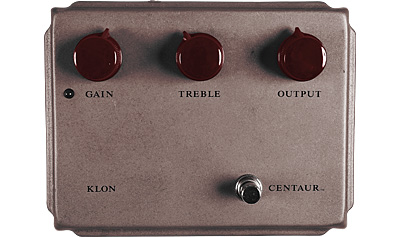
a Teese RMC3 wah, and a Klon Centaur. I also used a
1970's Fender Vibro-Champ on the [Back To Land] album. 
None of it is very rare, except maybe the Klon."

Ripley got satisfaction from his Klon Centuar
"Do you use any different gear live? I think I've seen an Ampeg and an SG?"
"Sometimes I play an SG, but otherwise it's the same."

"What type of SG are you playing on the stage?"
"It's an early 60's reissue."

"And did you get the Bigsby put on afterwards as an extra?"
"Nope."
Ripley onstage with his Gibson reissue

"How about amps, is that any different to than in the studio?"
I use a Twin [Reverb] most of the time. In the studio I've tried different things. 
I tend to like the Fender sound.

"Thanks for taking the time for the interview, man"
"No problem, dude."


You can find out more about Wooden Shjips' latest album, Back To Land, here.

Interview conducted by Dan Sharman.

Sunday, 19 January 2014

The Myrrors: Solar Collector Review


In the past couple of days Arizona-based psych-desert rock band, The Myrrors, have put up the tracks from their latest release, Solar Collector, up on their bandcamp page. Originally only available to those who bought the limited-edition cassette, the band has now kindly enough put up digital versions of the songs so all fans of the band have a chance to hear the new Myrrors' exploits.

Recorded in Tuscon directly to tape, this latest release captures a more natural, and live element, of The Myrrors performing ability. But, don't be mistaken, this latest EP of sorts, retains all the original charm and brilliance of the band's prior releases. Still ever present are the lazy bass grooves, mellow drum beats and searing guitar lead, this is the unmistakable sound of the The Myrrors. 

When we interviewed the band's guitarist, Nik Rayne in August last year, he claimed the Solar Collector tape would not only better reflect the band's true live sound, but would also act as an 'unpolished Kodachrome of that new stage in our evolution as a band', bridging the gap between the band's second, long-awaited album.

Described as 'three raw jams' which show the band 'stripped back to its essentials', the Solar Collector tape is a welcome surprise for all fans, whom have been waiting patiently for a new full-length from the band. Each track is perfectly mellow and strung-out, not rushing to reach any conclusions and instead, deliberately taking the longest route possible. 

Ascensión- 7:52
When selected, the album plays the second track on the EP first, Ascension, whether this be for artistic reasons or just an glitch in the system is unclear. What is clear though is that this is yet another golden piece from the Myrrors. Opening with an organ track which screams the influences of Terry Riley (a performer whom the band recently featured on their Facebook page), and with fluid cymbal crashes reminiscent of The Doors, John Densmore, from a track such as 'The End', the track is cut in two by the first few notes from Rayne's guitar, which is later followed by a backing of shimmering, Farsifa-esque organ chords. Shut your eyes and you can feel yourself slowly cruising down Route 66, dusty landscapes recreated in sound on either side, and the sun blinding yet, beautiful, gently laying down over your entire body.

Whirling Mountain Blues- 14:35
Opening with a fuzz-ridden, bassline it may be easy to mistake this track for an early Wooden Shjips song, such as 'We Ask You To Ride'. However, once again Rayne's Grestch bursts onto the sonic scene, this time the temperance of his playing noticeably more aggressive, ripping apart the bassist's created soundscape, with the accompaniment of the acid-rock beat in the background. 

Solar Collector- 7:00
The album closes with its own namesake's track, this cut more progressive than the previous tracks on the EP, similar to fellow neo-psychedelists, Naam. Slow and plotting, this track builds up in tempo and attack as it progresses. Slow and evocative in the beginning, this is a track which causes the listener to slow down and listen with the track, not allowing you to get too far ahead of it. 

As previously mentioned, the free-release of this new Myrrors' EP is truly a gift from the band, and will satisfy my own appetite whilst we wait for the release of the band's second full-length. Whoever you are, taking a half-hour out of your day to sit down and listen to this new cut will not disappoint, it being a perfect EP to relax to and surely not one to regret hearing after a long day. 

Critics Comment:  A perfect record to space out to, Solar Collector shows what the Myrrors can accomplish even when they aren't attempting to amaze. If the evolution of the band's sound demonstrated in this album is anything for fans and critics alike to go by, the anticipation for the second Myrrors LP release should be even greater...

Buy a copy of the limited-edition, Solar Collector cassette here: http://themyrrors.bandcamp.com/music

Monday, 23 December 2013

The More You Know: Guild's Take on the Solid-bodied guitar

In the early sixties, Guild Guitar Company were looking for a way into the electric guitar market, after years of making predominately acoustic guitars. Breaking away from the Gibson and Fender school's of guitar bodies, Guild looked to build a genuinely astetically-innovative guitar which wasn't like anything anyone had seen before. Decidedly, Guild put forward three guitar's into production; the S-50 named the Jetstar, the S-100 named the Polara, and the S-200 named the Thunderbird. All incorporated the companies signature solid-body design of the time and are now considered to be rarities, especially the S-200, a guitar which is played by The Black Keys very own Dan Auberach.  

Written by Dan Sharman.

Saturday, 16 November 2013

Travelling Circle: Interview + extensive rig rundown!!!

From left to right: Dylan Maiden; Josh Schultz and Charlie Freeman.

Last year pysch-rock power trio Travelling Circle released their latest album, 'Escape From Black Cloud'. A fantastic fuzz driven thrill-ride, the LP was notable for it's inspiring tonal flavours. Wanting to find out more, Do You Even Psychedelic? caught up with the band to find out more about the gear used on the record...

(This article is a follow-up to DYEP's review of the aforementioned 'Escape From Black Cloud', which can be found here.)

Note: images taken from Google Images, some instruments/pictures may vary from that of the actual band's gear arsenal. 

What guitars were used (with addendum regarding other instruments)?:
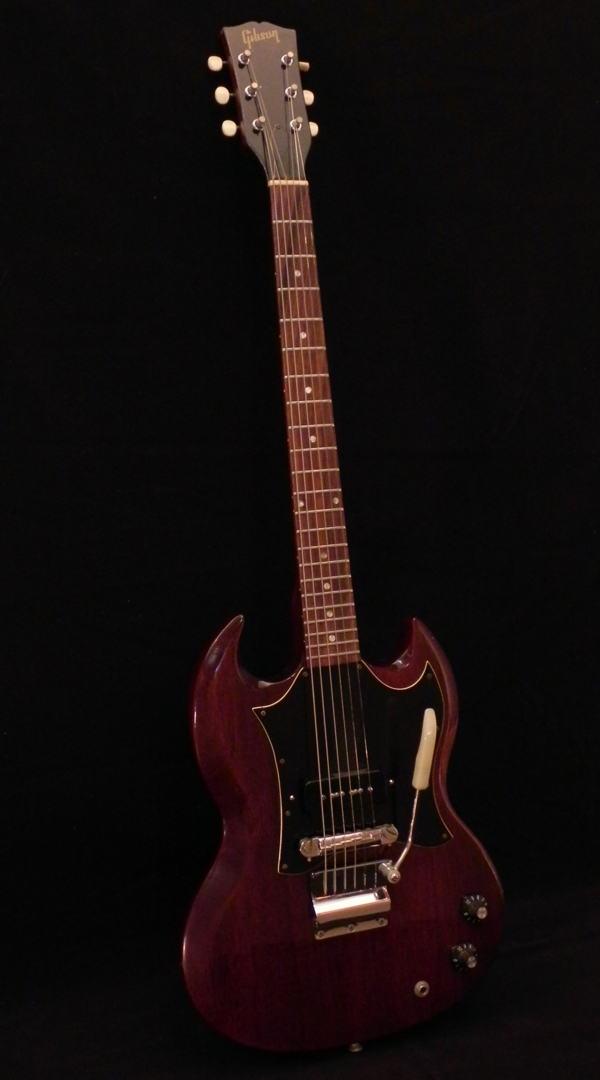
1967 Gibson SG
Dylan: I played my original Cherry Red 1967 Gibson SG Junior. It has a single P90 soapbar pickup.
The guitar speaks for itself and practically plays itself.   

Josh: I played an early stop sign badge Gretsch drum kit. Some unusual elements of my kit include a very resonant 24-inch bass drum and 14-inch deep marching snare (Ludwig blue and olive badge). I use a (synthetic) wool lined cork bass drum beater, which makes for a very boomy sound. Personally, I love my ride cymbal, I have had it since I was 12 or 13. But what about the bass, Charlie?

Charlie: I played a Fender P-Bass with flat wound strings. I much prefer the tone of flats over rounds and I think they suit our sound really well. On “Willow Tree Fair,” I played a Farfisa student piano that Josh gave me. Thanks again Josh! Dylan and I played a Fender Rhodes Piano on “Newborn Shadow” as well.

Early stop-sign badge Gretsch drum kit
without Schultz's modifications.
Josh:  I found that thing on Craigslist for only $25 and it 
made it on the record!  Sounds great too! I had to take the Long Island Rail-road out to Ronkonkoma to pick it up. Actually scoring my drums involved a Long Island trip as well. The guy I bought them from had been in a band that released some major label records a long time ago but he wouldn't tell me the name of the band! 

Dylan: This album also features Theremin arrangements by Matt Dallow and additional keyboard arrangements by producer extraordinaire, Gordon Raphael, who played an Arp Odyssey.


Josh: This is the synth part on “Tears From The Soul.” I actually didn't know Gordon used an Odyssey, I just knew it sounded great. Sweet!!!!!


What amps and pedals were used?:
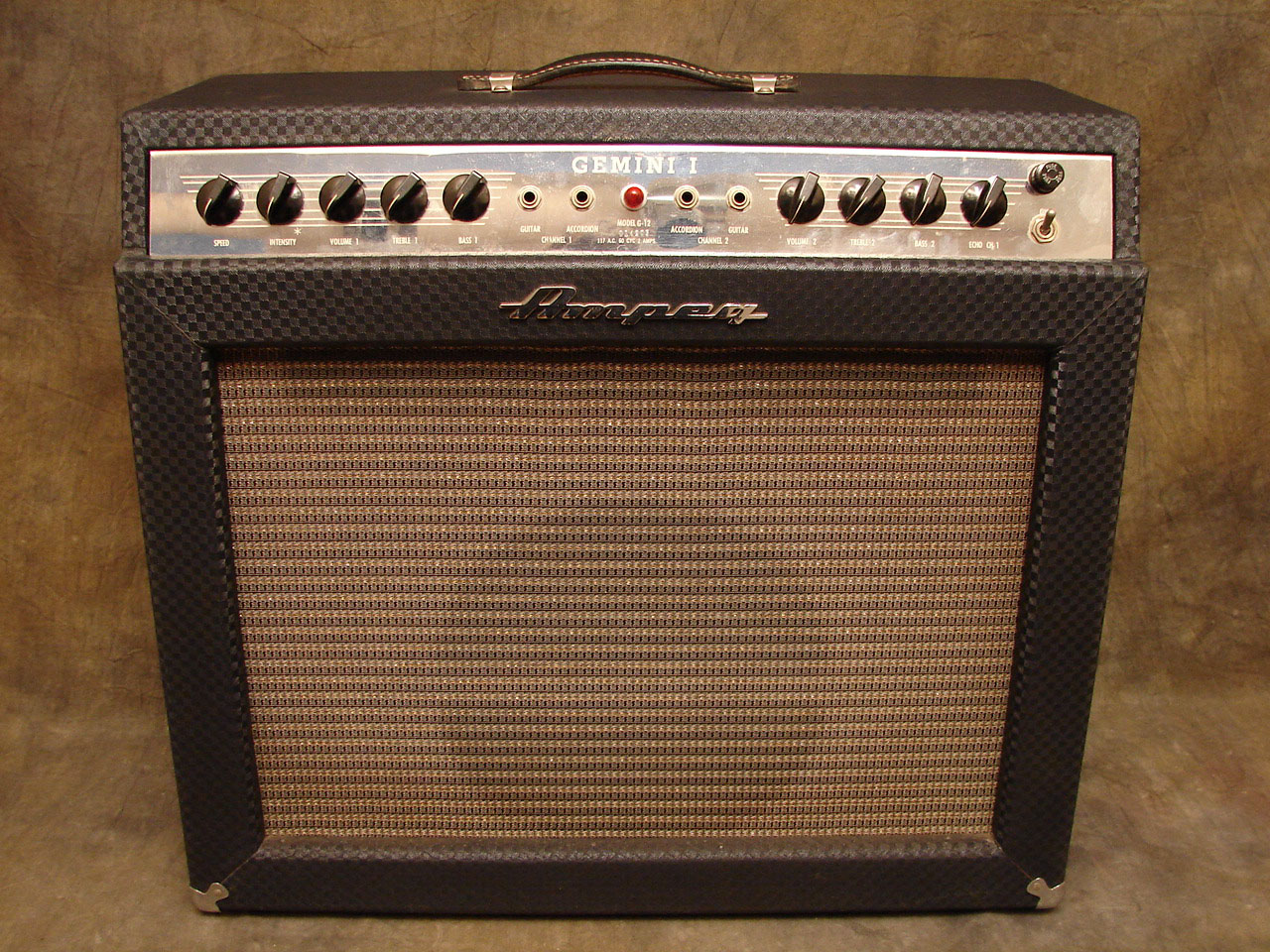
1960's Ampeg Gemini I
Dylan: I used a dual guitar amp configuration. On the left was a 90’s reissue Fender Twin Reverb and to the right a 1960’s Ampeg Gemini I, with my SG inputted through the reverb/tremolo and accordion channels, respectively. My pedal arsenal included a 1980’s Electro Harmonix Big Muff, mid 1970’s MXR Flanger, 2000’s MXR Carbon Copy, 2000’s Electro Harmonix Hum Debugger and 2000’s Morley Splitter, which allowed me to create a stereo and quadrophonic effect on demand, ranging from reverb, fuzz, delay to flanger.

Josh: Dylan is a feedback wizard! I love the Gemini. I have been looking for a Gemini II, which has a 15-inch speaker, for my own dark purposes.

A vintage Kustom 250 Tuck & Roll.
Charlie: Dylan’s set-up is pretty epic. I played through a late 60’s Kustom 250 Tuck and Roll amp, running through an early 70’s Plush cabinet. I used a 1970’s Ross distortion pedal on some songs but very minimally.

Dylan: Yeah, but when you did use that Ross pedal Charlie, it was pretty fucking awesome. Minimal, but fucking awesome.

Details about the Escape from Black cloud sessions: e.g: Where/how it was recorded, ect. 
Josh: Both our records were recorded at Seaside Lounge in Brooklyn, NY with our friend Mitch Rackin. That place is the best!!! 


Dylan: Yes! Polish sandwiches and beers a block away.


Inside Seaside Lounge recording studios, Brooklyn.
Josh: They record to tape and have tons of cool stuff like the Roland Chorus Echo, a Rhodes, a Wurly, a Hammond, spring reverb, plate reverb -everything! Mitch is the best too!!! He put out a record a few years ago with a band called Heavy Hands (not the Scottish HC band) which is great if you can get your hands on it. His list of recording credits is long and he has worked on some sweet stuff. We recorded the basic guitar, bass and drum tracks for Escape from Black Cloud all in one big room but with a lot of mic options, room mics etc. Then Dylan and Charlie recorded their vocals and Charlie added some great keys. The Theremin was recorded in my apartment. We found Matt Dallow via craigslist and he came in and did a great job. Gordon Raphael took the tracks from there and mixed them and added a few bits somewhere between Berlin and Texas. He did a really great job. I am really happy with how it all turned out!

A Roland 'Space Echo' unit, just one of the many cool things
at Travelling Circle's disposal when recording the new LP. 
Dylan: We kind of removed ourselves from the whole process of post-production and just left it to Gordon. When I first heard what he had done I was a little challenged to be honest. There were aspects I was uncomfortable with in terms of the overall depth. But in retrospect he really helped capture what we were thinking and feeling when we wrote those songs.

Josh: Mixing remotely was a real interesting process. We had to be pretty sure of the changes we asked for because then Gordon would have to go back to work and then get us another version. He was really easy to work with though and patient with us. He put more bass in the mix than probably would have been done if we were all sitting with him in the control room, and when I heard it I thought wow, these songs really move!!!! It changed my thoughts about the place for bass in a mix. Gordon deservers a lot of credit for the density and drive these mixes have.

Follow up and new material: e.g: lessons learned, new projects,ect.
Dylan: Right now I'm working on songs for a new project in Australia. The style is very song-writerly and sort of arrangement-driven with elements of cinema, country, folk, psychedelia, space rock and undeniably some vestiges from my experiences with Travelling Circle. It’s all virtual session work on Protools at the moment. But once the songs are ready, I'm sure I’ll be calling on Josh and Charlie for assistance. The three of us are kindred souls when it comes to writing music. We share similar musical propensities. When I'm playing with these guys, they just know what to do.

Youth of the Beast's latest album; 'Seventy Seven'.
Josh: I am going to be playing drums with some friends on some recordings they will be releasing in the next few months. Their band is called Youth of the Beast. It’s not psych but it has been fun to work with them. I also put some combo organ tracks down on the demo's. I will be curious to see if the organ parts survive to the final mixes!  They sound good though so maybe they have a 50/50 shot at surviving! I constantly make noise at home but nothing really shareable. I picked up a Realistic Concertmate MG-1 for a great price recently so I have been messing with that a bunch, going down the dark road of analogue synthesizers. I'm certainly up for helping on some D. Maiden jams! We (Travelling Circle) got an offer to do a song for a comp from the great psych radio program Trip Inside This House from Saint Louis. I haven’t actually discussed it with Charlie and Dylan yet. Do you guys want to do it?

Charlie: Let’s do it! I've been working on some projects at home too, trying to strengthen my song-writing skills. They’re pretty much just simple, folksy, hippie songs. I would love to try some long-distance recording sessions with these guys though. I think we could come up with something pretty far out.

Dylan: I'm definitely up for some tri-coastal session work.

Josh: Well in that case, keep an eye out for our track on an upcoming Trip Inside This House compilation!  

You can find the whole of Travelling Circle's new album here: Here!

This is what we said about Escape from Black Cloud: ''★★★★ - Very good, This album exceeds expectations in nearly all areas, begging the question, why is this the first we've heard of Travelling Circle? Get ready for a fully-stereo, fuzz driven thrill ride that will sit snugly into your Sunday evening and beyond...and yes, it's true bypass.''

Like the band's Facebook page to keep up with events: Here!

Do you even psychedelic? would like to thank the band for this interview.

Interview conducted by Dan Sharman, posted on 16/11/2013.