Friday, 31 October 2014

Paraíso Flotante interview with Anna Cuadra and Pedro Fukuda!!

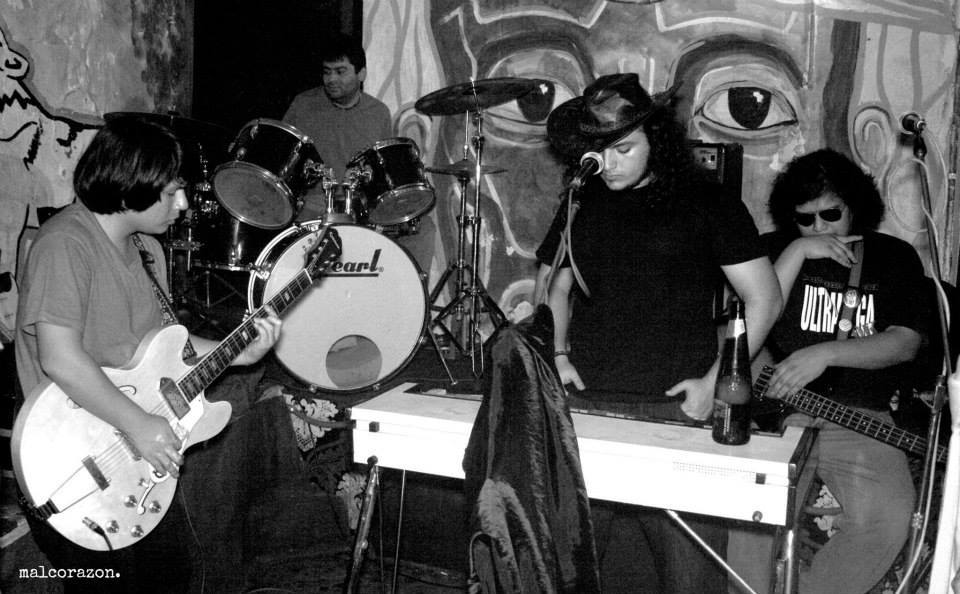
Continuing onwards with my series of Peru-based band interviews, I take a step back of sorts to delve into the minds of two ex-Montibus Communitas (a band whose interview kicked off this series) now performing together in their new group, Paraíso Flotante - a similarly experimental improvisational group. - Interview conducted by Daniel Sharman.

Dan: Where do you guys hail from, and who is in the band?

Anna: Well, for me, this kind of question is long to explain.  my place of birth was in Lima Perú but grew my whole life in Bogota Colombia. It’s was basically  me and Pedro, though before Pedro had been playing with other musicians under the same name. After a while it was hard to get everyone together so it established more between the two of us.

Dan: What were you doing previous to this band, and what inspired you to form Paraíso Flotante?

Anna: I had just arrived from Argentina a while ago and was recording my songs and playing with some local bands. Practically Pedro invited me to play in an acoustic & live environment, the day we had met in Brayan's place for the first jam, we had a real connection in our improvisation that day and we wanted to keep the same rhythm but exploring other “air” spaces.


Dan: Being an improvisational group, how do you go about writing? I mean to say, what inspires you and gives birth to the music you produce?

Anna: For me, is the need to play, then later we manage to remember and write in a creative unstructured way the things we want to rescue from our jams. Though, unfortunately we never recorded any of our jams together with Pedro.

Dan: What sort of bands, and records influence you? I think I heard some Gong-esque chants in gan/río prohibido.

Anna: Normally I listened to Soft Machine, Fleetwood mac, Gong, and King Crimson, whilst going to school,  but also, Herbie Hancock, Jaco Pastorius, Laurie Anderson, John Zorn, Mike Patton etc. and composers like Steve Reich, Arthur Russell, Arto Lindsay, Jun Miyake, Eyvind Kang, Raul Zarate, Brian Eno and the list goes on & on. I listen to albums like “Dark side of the Moon” by Pink Floyd; “The Youngs” by The Youngs; “Tierra” by Julieta Rimoldi; and “Parallelograms” by Linda Perhacs.

Pedro: I like Gong, but I don't really know their music that well. We all have different music that we like in this band. I like the art ensemble of Chicago, they have an influence on me. Secret Chiefs 3, Masada, Hamid Drake is one of my favourite drummers. I'm also into Baba Sissoko, Konono (the mbira band) and Oumou Sangare. Lately, I mostly listen to podcasts and audiobooks like the Church of What's Happening Now and the Illuminatus Trilogy audiobook on YouTube, which is brilliantly performed.


Dan: How/where were the albums recorded?

Pedro: So 'Gan Rio Prohibido' was recorded in my apartment by a friend's (the Singer) laptop . I don't have any kind of studio set up here it's just a rehearsal space, so the sound is not the best. I think you can hear the same dog  barking through the whole session which I kind of like. This particular session features my long time friend's Tete Leguia who is a brilliant bassist, and composer as well, who plays in many bands, and Carlos French who is a singer that also plays a lot electronic keyboards like Moogs and such.

Dan: What were some of the instruments used on the recordings? E.g: percussion, strings, ect.

Pedro: The instruments on that song I don't remember that well, but there's an acoustic nylon guitar  played with drumsticks (like Cairo Heroin-infused Street musician style); Tete on bass, there's an irish flute, a quena, drums, and we all sing.


Dan: What is next for Paraíso Flotante?

Anna: We have plans of recording virtually, but most important now is playing on live. Meanwhile, I guess Pedro will continue in Perú and me here in Argentina.

Pedro: I don't know. We´re not active now, although Nik Rayne [of Sky Lantern Records) is releasing a tape of our's. But, everyone from the band is playing, doing their own thing. I play in a crazy jazz trio with the bass player and Marco Mazzini - an amazing clarinet player from here. Carlos has his doom band. El Jefazo and I still play with Chicho who was a mayor presence in Montibus Communitas too.

Dan: Right, so you are an ex-montibus communitas member, can you tell me about that time?

Pedro: I met Brayan, who at that time called himself Brayan Buckt (his real name is Brayan Tipa), at this concert in Lima and I asked him to play, we jammed at his place and the second time I went there I met Anna and Sergio and that's when we recorded the material on the first LP. I started playing a lot with Anna and Chicho after that around that time Montibus had its first gig in Koca Kinto, which in my opinion is the only really good gig we ever played. After that people got excited and we wanted to rehearse and share ideas but Brayan said ''NO''! He said that the band was free-wheeling, that there would be no rehearsals... So we  kind of went fuck that and did our own thing.


Dan: We reviewed Pilgrim to the absolute recently, what do you think of that record?

Pedro: Well, now we're not in the Stone age there is Google. You know one time I went in there and put Montibus Communitas into search and there was all these interviews saying anybody could be in that and that we are mystics living at the edge of a river and that's when I got upset. No one ever asked if we liked that name Montibus Communitas. And it was a band with fixed members since Chicho played with us, Brayan brought in another bassist who didn't really click with us. 

Also most of the parts I played are credited under Brayan's name. After that we all left and we don't know anything about the band and we don't receive anything for any releases.

Dan: Lastly, is there anything else you would like to say?

Anna: Let there be more musicians able to risk their oneself to become one with music. Fashion and fame are good and motivating, but it comes and goes as fast as the wind. Kill your own idols & maintain yourself to be true to your real own essence.

Do You Even Psychedelic? would like to thank Anna and Pedro for taking the time to complete this interview. 

Make sure to like the band's facebook page here.

You can hear the band's music on their Soundcloud, here.


Tuesday, 28 October 2014

Happy Trails: John Cipollina's Guitar Rig + Technique Analysis - Chapter 2: Amps and Effects (Editorial)

Rig Rundown - Guitars - (see introduction here)

Several months ago I started a series on the guitar rig and playing techniques of the late, fantastic John Cipollina. This instalment will touch on Cipollina's amps and effects, you can read the first chapter, which focuses on his choice of guitars, here.

Amps: The amp set up Cipollina implemented was an integral part of his signature sound, and can be seen as driving force in solidifying the psychedelic sound of the San Francisco music scene of the 1960's. 

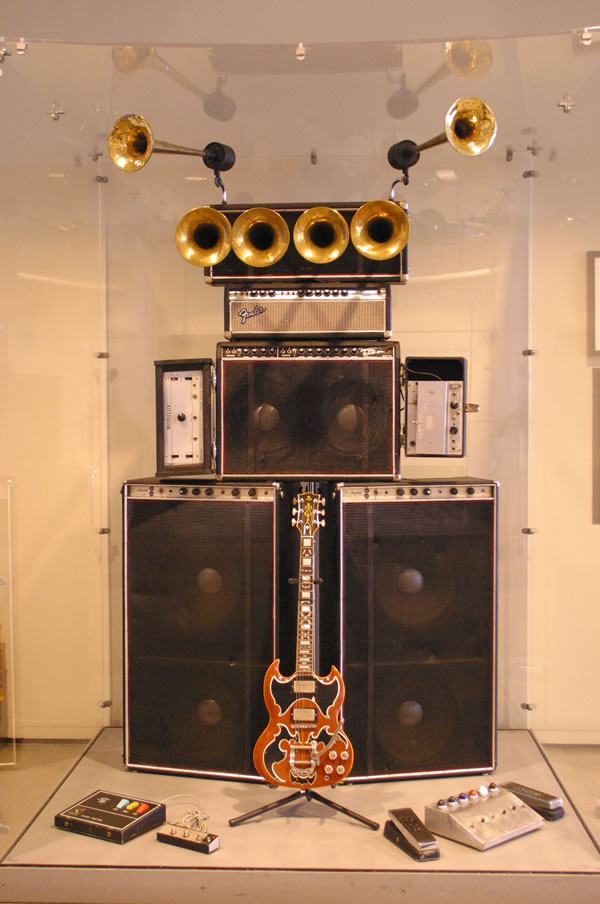
Cipollina's unusual selection and combination of amps resulted in an entirely unique amp stack. On the bottom of the stack sat two solid-state Standel bass amps, each of which were equipped with two 15 inch speakers. In contrast, on the top of the stack sat two Fender tube amps: a Twin Reverb sporting two 12-inch speakers, and a Dual Showman which had been modified to drive six Wurlitzer horns. 

As previously mentioned in chapter one, this set up was deliberately designed so as to form a symbiotic relationship with the guitar. Cipollina's SGs were wired to have one pickup going purely to the Standel bass amps, and have the other pickup going purely to the Fender guitar amps. This meant Cipollina could play with the low crunch of the Standel amps and the classic spiky cleans of the Fenders simultaneously. 

"I like the rapid punch of solid-state for the bottom, and the rodent-gnawing distortion of the tubes on top" - John Cipollina

Lastly, Cipollina also used the driven Wurlitzer horns to good effect, using a foot-switch to turn them on and off. When pushed by the Dual Showman, they provided a familiar rounded tone with overtones of distorted tube breakup (An example of the horn tone can be heard in Quicksilver Messenger Service's 'How You Love').

Effects: Moving onto the last element of Cipollina's famously extraordinary rig, we come to his effects. Although much of Cipollina's sound was provided courtesy of his eclectic amp selection, some of his tone was derived from effects pedals and units.

Most notably, Cipollina's Twin Reverb sported two tape echo machines, one fixed to either side. On the left clung a Standel Modulux, and in similar fashion, so did a Astro Echoplex on the right (scroll down to bottom for image of stack). Like the horns, operation of these was controlled by foot-switch. Quicksilver Messenger Service's 'Mona' provides a perfect example of these echo machines in use. 

Alongside these units, Cipollina also used several Vox wah pedals, which he often used to modulate his guitar signal when using his tape-echo's (once again, hear 'Mona'). For a fuzz, a Gibson Maestro was used (the same pedal used by The Rolling Stones on 'Satisfaction' and by The Doors on 'Hello, I Love You'). Volume pedals were also used when a song called for less distortion for example. 

Saturday, 25 October 2014

The Social End Products Interview with Sta Stea!

Tired of sampling your rock and roll only from the American school of musical psychedelia? Well, threat no more as we take a journey into the mind of Athens-based  quintet, The Social End Products. Drawing from the golden era of European psychedelia, the group captures all the pop rock spook-psych charm of the generation, but modernises it into a fresh, Greek package. - Interview conducted by Daniel Sharman.

Dan: Hi Sta, would you like to introduce yourself?

Sta: I'm the drummer and lead vocalist of the band. I also write the lyrics and some of the music.

Dan: Who else is in the band, and where is the band situated?

Sta: Manos plays guitar and performs vocals, Sara performs guitar/organ/vocals, Themos performs bass/vocals, and Myrto plays flute.


Dan: The band name 'Social End Products' is a very poignant name, where does it originate from?

Sta: We took our name from the title of the song of the same name by New Zealand's THE BLUESTARS. It represents us!

Dan: You guys have a sound reminiscent of the old, European psych groups of the sixties. What are some of your influences?

Sta: I would say we are more influenced from the American bands of the 60s and even more from the South American ones like Aguaturbia, Laghonia, etc. and also very much from sixties Greek bands like Peloma Bokiou, Nostradamos, etc. I feel those influences are more obvious to our new recordings.


Dan: On the band's facebook page, many interesting pieces of vintage gear can be seen. What guitars where you using on your latest sonic outing, Nutre Tu Cabeza?

Sta: Yes we love vintage instruments and when we find something interesting (and cheap) we buy it! Unfortunately, when we were recording our LP didn't have all that so we used a Fender Jaguar and a Fender Jazzmaster. But, on our new recordings we used our EKO guitar collection! 12-string Cobra, Auriga and Melody.


Dan: And how about amps, and effects?

Sta: We have a Fender Twin Reverb and an EKO Herald IV. We use a lot of effects, but think the most interesting is our sixties EKO Multitone.

From left to right: (top) Twin Reverb, EKO Cobra,
Fender Jaguar. (bottom) EKO Auriga. 

Dan: What about any other instruments, such as keyboards, drums, ect.?

Sta: We also use a 70s EKO Tiger Junior Organ.

Dan: Where did you record the latest album?

Sta: We do all our recording's at FEEDBACK SOUND STUDIO in Athens. It is the best for a vintage sound and our producer Harris Zourelidis is a true master of sound!!!


Dan: What have you learnt from Nutre Tu Cabeza's completion?

Sta: It's been very nice in the studio and tripping in the world of sound. Especially when you want to reproduce a sound of the past, you get to have a journey through time.


Dan: What's next for the Social end products?

Sta: We are recording new songs now. Two of them 'FEELS MUCH BETTER ON THE OTHER SIDE' and 'UTOPIA' will be on a 7". That will be out next month on Garden Of Dreams Records, the coolest label in Greece right now. The rest will be in a full LP, which is coming some time in spring. We also have some gigs this month with TOMORROWS TULIPS in Athens and with ALLAH-LAS in Thessaloniki.


Dan: Lastly, are there any shout-outs you would like to make?

Sta: We would like to thank everyone supporting us worldwide. 

Do You Even Psychedelic? would like to thank the band for taking the time to complete this interview.

Find the band's latest LP, and their past 7", here.

You can hear the single from the band's upcoming 7", Utopia, here.

Make sure to keep up to date with their Facebook page here.


Saturday, 18 October 2014

The Cosmic Dead: The Cosmic Dead Début Review

Nik Turner might be touring with legendary space rock heavy-weights Hawkwind once again, but The Cosmic Dead are here to show that 
[inter-]stellar music might be closer to this point in time than you might of first thought. - Review by Daniel Sharman.

Released in: 9th May 2011
Genre: New Age Death Psychedelia
Record Label: Cardinal Fuzz, Paradigms Recordings 
Medium: Double Vinyl, CD, Digital Download
Recorded at: The Moonshaker

From the outset, this début captures all of the wild, visceral impact of a wilderness psychedelia record, but repackages it in a brand-new, space rock-drenched form. The album features a number of musicians, but all of the vocal and guitar work is delivered by cosmic mainstay, James T McKay, whom, much like the rest of the album's musicians, understands the importance of playing just what the jam calls for - gentle and nuanced at times, forward and blatant at others. Drawing heavily from space rock icons of yesteryear such as Hawkwind and Gong, whilst simultaneously remaining fresh and unique in light of its contemporaries (e.g: Electric Moon, Mugstar, Carlton Melton, etc.), The Cosmic Dead's début LP brings a whole new brand of moribund excitement to the psychedelic rock stage.

The album kicks off with 18 minute opener, The Black Rabbit (a possible Jefferson Airplane reference?), which starts off with a synthesiser raga of sorts (once again reminiscent of Carlton Melton), one which provides a gentle start to the album whilst also giving it a feeling of levitation. After this three minute introduction drums, bass, and guitar explode into the mix, now accompanying the floating synthesiser work. The guitar playing is wild and unruly, throwing distorted licks up from the grounded arena of the bass and drums into the air so they may sit next to the work of the keys. Additionally, the guitar work on 'Black Rabbit' is somewhat more planned than on the other tracks, all the playing being performed around a central melodic theme. Near the end of the track, bass and drums are also allowed time for experimentation along with guitar and synth. 

Moving onwards, the album's second track, Spice Melange Spectrum, seems to adopt a more conventional length when compared to the débuts other track's. Moreover, 'Spice Melange Spectrum' is perhaps the most intriguingly titled track of the album, receiving kudos from for its implementation of obscure, French vocabulary. McKay's use of Wah on this track is used fruitfully to create whirling sonic landscapes, once again driving home the feelings of levity and etherealness. This guttural guitar work should have immediate appeal to fans of Ripley Johnson's playing on the early Wooden Shjips records, and also Nik Rayne's playing on the latest Myrrors release, Solar Collector (review here). 

The track's third album, Infinite Death of The Godhead (another intriguingly titled track), returns to a more familiar duration (13:44 minutes). This track is more focused on the power of the bass and drums, especially in combination, and appears to be almost minimalist in their repetitive, droning attack. Furthermore, vocal drones are provided by McKay himself, giving validity to the previously made Gong comparisons. Also, thanks to the continuing onslaught of the bass and drums, McKay's guitar playing is given the chance to take on a slightly more spaghetti western edge with waving, sinuous chords working their way in and out throughout the song, aided by classic surf lines of sharp, short bursts of twangy, reverberated action.   

Lastly, clocking in at 40 minutes, 'Father Sky, Mother Earth' (the title 'Mother Earth' further evoking notions of the aforementioned wilderness rock connotation) constitutes half of the 80 minute runtime of the album, and so demands an analysis on the merit of its duration alone. The track is a delicately jammed out closer, utilising a great, panning synthesiser sound throughout to give the track a true feeling of levitation. The track also relies greatly on the inventive work of bassist, Omar Aborida, to give structure and tonal nuance to the lengthy instrumental, the bassline ranging from a repetitive, driving sonic-propellant, to a droning, fuzzy backdrop. The drumming on the track is of a similar nature to that of the bass, providing a range of percussive voices, whilst still perpetuating a composed, unintruded atmosphere. This instrumentation creates an ideal stage for the once again, classically psychedelic guitar work and vocals of McKay, which makes use of a full range of effects, giving the album's ending a familiarly rock and roll feel. 

Critic's Comment: This may be a dense, lengthy review of a lengthy album, but don't believe for one minute that this début's content is anything but light and ethereal. This album is a perfect example of how focusing on producing the music that you want to create, with no concerned thoughts for conventional standards such as condensed duration, is perhaps the best way to produce quality music that will remain timeless and enjoyable no matter how many times it is played. Do yourself a favour this Saturday and sit back, eat a banana, and enjoy this one hell of a record.

Friday, 17 October 2014

The Dead-End Alley Band Interview with Sebastian Sanchez-Botta and Javier Kou!

43 years ago listeners from across the globe took the needle off of their copies of L.A Woman, left with nothing but the harrowing vocal refrain of Jim Morrison singing 'Riders on the Storm'. Over four decades later, Peru-based psychedelists, The Dead-End Alley Band, are bringing it all back. Taking inspiration from the past, this group are creating some of the most authentic-sounding blues-based, stoner rock to come out of the South American continent in recent times. Enjoy the latest instalment in our continuing series of interviews out of Lima, Peru. (read instalments one + two). - Interview conducted by Daniel Sharman. 

Dan: Who is in the band, and who plays what?

Sebastian: Hi, Daniel. Well, this psychedelic adventure started with Javier Kou, playing guitars, bass and some vocal, and me, Sebastian Sanchez-Botta, playing vocals, organs, piano and some drums. Then, on the road, we added a couple of friends to perform live. They are Leonardo Alva on lead guitars, and Jaime Diaz on drums, so, the final line up is: Me on vocals and organs, Javier on vocals and bass, Leonardo on guitars, and Jaime on drums.

Dan: Where does the name The Dead-End Alley Band originate from?

Javier: Besides psychedelic music, I like some other genres and bands, so the name came up a long time ago between 2006 and 2007 when I was listening to Enrique Bunbury’s new album (in that time) in collaboration with another Spanish singer named Nacho Vegas. One of the songs of the album was ‘Welcome to El Callejón sin Salida’ and I liked the part of ‘Callejón sin Salida’ that in English is ‘Dead-End Alley’, so I just put the ‘The’ at the beginning and the ‘Band’ at the end and that was it: The Dead-End Alley Band. I saved that name for some years till I told Sebastian to start this project.


Dan: Some of the Dead-End Alley Band's songs are very organ-focused, not all too common in the often guitar-dominated world of neo psychedelia. What caused you to bring organ into the mix?

Sebastian: It’s because, our first influence to start making psychedelia were ‘The Doors’. Their music had a lot of Ray Manzarek’s organs presence, so we started loving that kind of mix between laced-cheesy-obscured organs with some delayed and fuzzy blues guitars.

Javier: Yeah, and also, in my opinion, the organ plays such a big role in the music we create, is like the nexus between the real world and the trip we offer.

Dan: Your sound contains a wide variety of band's, such as The Doors, The Deltones, Country Joe and The Fish, etc. What are some of your influences, and current favourite bands?

Javier: For the band, some other influences besides the ones you already mentioned are ‘Iron Butterfly’, ‘Phantom’s Divine Comedy’ and maybe some of ‘Vanilla Fudge’. Also when I have to create bass lines some of the influences are from Deep Purple’s Roger Glover and Black Sabbath’s Geezer Buttler. And talking about favourite bands, if I have to name 5 I would say: ‘The Doors’, ‘Alice in Chains’ (the old one without the new vocalist), ‘Alice Cooper’, ‘Héroes del Silencio’, and ‘Judas Priest’.

Sebastian: And for me, my personal influences in organs comes, besides Ray Manzarek, from classical music, some goth organs from Tim Burton’s movies, for example, or some sixties horror b-movies.


Dan: I notice that Javier Kou plays both guitar and bass on the records, how does this work in a live context?

Javier: Like Sebastian said, we had to add some people to play live, so, I play bass at the concerts, because Leonardo is so much better guitarist that I am.

Dan: Why was Leonardo Alva brought into play lead on the track 'The Cosmic Cry Out'?

Sebastian: When we included Leo in the band, we found that he is a blues man. He had a very sweet and sexy “hendrixian” way to seduce with his guitar. ‘The Cosmic Cry Out’ it supposed to be a very sensual track, so… the man with sensual bluesy solos must be there.


Dan: I feel like I'm interviewing a tonne of bands from Lima recently! First Montibus Communitas, then Spatial Moods, and now you guys! How do you feel about the Lima musical scene?

Sebastian: I have a personal feeling about Peruvian’s rock and music as well. I think that the most representative sound of Peruvian rock is the psychedelia from Traffic Sound, Laghonia, Los York’s, etc. Then, combined with the popular ‘chicha’ (psychedelic cumbia), it seems to be that psychedelic sounds are representative from this country. Is not weird, at the end of the day, to find out that we are living in a psych rock camp. A lot of bands here love having a psych sound in their style, and finally you realize that psychedelia is good looking outside, but in Lima, it lives in a very underground world.

Dan: What guitars were used on the Odd Stories recording sessions?

Javier: I like the question, man! Hahaha, Ok!, we used 3 different guitars, a Thomas guitar (A vintage Japanese copy of a Mosrite guitar), an Ephiphone Hollow Casino and 1968 Univox, provided by our friend, brother and co-producer, Chino Burga (from La Ira de Dios).


Dan: Also, what organs/keyboards were used on the album?

Sebastian: Since we started playing and recording, I play with a Farfisa Fast 5 organ, from 1969.

Dan: How about amps and effects (for both organ and guitars)?

Javier: Vox pathfinder and Marshall.


Dan: In a more general sense, what were the Odd Stories recording sessions like? Why did you decide to overdub the sound of rain onto tracks like 'Blue at a distance'?

Sebastian: We used to record in our home studio. Also, we record some tracks in some friend’s houses or studios. For example, drums were edited and mixed at Jaime Diaz studio. ‘Blue At Distance’ is a track with some feelings of loneliness. The story of a lonely guy walking through the streets at night, under the rain. We thought the sound of rain could increase that feeling of loneliness we wanted.

Dan: Who created the artwork of Odd Stories? And what does it depict?

Javier: Sebastian came with the whole illustration, and I made the work in photoshop.


Sebastian: It's an "odd story" too, hehe. The first song we composed for this album was Devil's Mask. It was my favorite song, and also, I told Javier to have that song as a single for the album. I thought the album will be called 'Devil's Mask', so I draw this weird guy with a 'diablada' mask, representative from the southern highlands here. When I wrote the lyrics and thought the story of the song, I decided to use that mask, because it's very crazy. It looks very mad and psych, too.


Dan: What's next for The Dead-End Alley Band?

Javier: Actually we are working in some demo's for the 3rd album, I guess we have the songs we want to record in a close future, but I would like to have more songs so we can choose some of them and save the others for b-sides or compilations with other bands. That’s all I can say about.

Dan: Is their anything else you would like to say or any shout-outs you would like to make?

Javier: Hmm, not really, we are preparing the official release of the LP here in Lima, also some labels here are working now on the CD and Tape editions of the ‘Odd Stories’ so it will be a complete album release, a big party (or slaughter… hehehe)! Also we would like to thank to all the people who have been supporting us since the beginning, I won’t say names ‘cuz it may take too long, and thank you for the interview and the time.

Sebastian: Just hit “play” and let yourself get carried away by a night of pure madness!!

Check out the fantastic new Dead-End Alley Band record, Odd Stories, here

Also, make sure to like the band's Facebook page to keep up to date, here