Showing posts with label Psychedelia. Show all posts

Saturday, 17 October 2015

Pandelindio Interview! / Entrevista Pandelindio!

Harking from over the hills and far away (Argentina to be precise), Pandelindio's shamanistic blend of meditational drone and invigorating Indian and Middle-Eastern currents provides a gateway to the Susurrus like no other. Employing a flute set up unique to the group, Pandelindio have a sound distinct from others, with a softer, more introspective edge than contemporary drone bands. Wishing to find out more, we caught up with the band to discover the roots, composition, and future of this most distinctive South American act. - Interview conducted by Daniel Sharman. 

Q.) Who is in the band and who plays what?

A.) At the moment we’re playing live as a trio. 

I play Bansuri, N’vike, Hulusi, Pythagorean harp and Bamboo clarinet. Juan Manuel Claro plays Dilruba, Duduk and Bawu and Corina Inveninato plays Tambura, Shruti box, Didgeridoo, Tibetan bowl and Citarina.

We’ve been playing kind of the same set with those instruments this year, but there are many other friends who participate in the recordings and have participated in previous gigs of Pandelindio.

Q.) It's great to interview a South American band, can you tell us more about where you are located?

A.) We're from Buenos Aires, Argentina and we live in Quilmes city. Quilmes is at the shore of the "Rio de la plata”, known as the widest river of the world. But in my opinion the most important thing in the city are friends and family. Besides that and sadly to say it's not much more interesting.


Q.) Pandelindio is an interesting name. What does it mean exactly?

A.) Pan del indio (Indian Bread) it’s an edible mushroom from the Patagonia. Its scientific name is Cyttaria harioti and it grows on trees, it’s orange and spongy like a tangerine,  I ate a few and it doesn't have much taste. The native tribes Yámanas o Mapuches they used to eat it fresh or elaborate an alcoholic beverage with it.


Q.) Who influences you as a group musically?

A.) Musically the album “Accordion and Voice” from Pauline Oliveros was a great influence at the time I discovered it and “Ayahuasca” from Pelt was another one. 

Also sharing time and playing with my friends like Golondrina Alfa (http://golondrinaalfa.bandcamp.com/) and O+yn (https://omasin.bandcamp.com/) gave me the shape of how to approach the improvisation.

Then, on a conceptual level of experimental music the documentary of the band “Reynols” Influenced me a lot. I believe it’s great, essential. (http://www.cinemargentino.com/films/914988456-buscando-a-reynols - English subs)


Q.) Your music focuses strongly on drone and drawn-out repetition. What attracts you to this compositional style?

A.) The hypnotic state that creates. To me the repetition it is fundamental to develop the melodic composition and sometimes the drone variations are enjoyable enough.

Q.) Are any of your songs ever pre-written or do you produce them on the spot as you play?

A.) I personally like to set up the scale or tonic in what we’re going to play and what instruments. The song or composition comes out always from an improvisation and then we develop that melody or form.


Q.) What part does Nature play in the creation of your music?

A.) A big one.

Some of my best experiences were listening to birds, crickets and toads singing altogether like a psychedelic trance orchestra or the bass drone of the water going down the creek bouncing on the walls. The natural environment always inspires me to listen deeply.
I enjoy a lot to do field recordings and use it in songs.


Q.) I noticed you described your music as meditational. Would you say music can ever help humans transcend the self?

A.) I don’t know if our music fits in the traditional genre of meditational music but it’s kind of my meditation. It helps me transmute emotions or quiet the mind but to transcend the self or take awareness I believe it takes more than music. Shamanic plants for instance, are a great ally of music and they work more intensive and deeply to take consciousness on the "self". But everyone has their own path so I couldn't say for sure.


Q.) Your music is incredibly rich in texture, can you tell us more about the instruments you use to create this?

A.) I'm a big fan of ethnic instruments, mostly from hindustani classical music. I don't have a musical heritage or try to represent any culture so I like to explore the combination of instruments from different places. For example, sometimes we mix the Mbira (African) with a drone-based Tambura (India) or we play the N'vike, which is a bowed string instrument from the indigenous "Toba" people, with the didgeridoo (aboriginal trumpet from Australia) and the Indian's violin Dilruba. Whatever sounds good to us, we try it.   


Q.) You're an instrument maker yourself. Can you tell about what that is like to do as a career, and how it impacts your music?

A.) I started to make instruments for myself. I made Didgeridoos for my friends and a couple of Bansuri (traverse flute from India) in pvc and later in bamboo. Luckily I found a passion in making instruments and I keep doing it since then. It's a great pleasure to make an instrument for someone, who's probably a musician or a music therapist. I'm very happy and grateful to make a living of it. I play mostly the instruments I made so it has a big impact on my music.


Q.) What is next for the band? Any upcoming albums or live shows?

A.) We have a new album coming out soon named "Mount Analogue". We recorded it with Pablo Picco and he also work very hard on the mix. And the amazing collaborations of musicians that I admire like Ulrich Rois from Bird People, the guitarist Mariano Rodriguez and my partner Corina Inveninato that was sick with fever when she recorded the piano tune. I'm very happy and excited and probably released it on tape next month. We're playing live this month on saturday 24th with Dario Dubois Duo (https://darioduboisduo.bandcamp.com/) an amazing drone-kraut band from Buenos Aires. And on november 6th we're playing next to Diente de Madera, one of my favourites band right now (https://dientedemadera.bandcamp.com/releases) and Nicolas Melmann too, I believe. He (http://melmann.bandcamp.com/) is a great minimal-ambient composer.

Do You Even Psychedelic? would like to thank Pandelindio for taking the time to complete this interview!

Make sure to like the band's Facebook page, and thus stay up to date, here.

Make sure to check out the band's work here. 

By Daniel Luke Sharman

Wednesday, 5 August 2015

Bird People Interview with Ulrich Rois!


The Forward Path, closing song of the Myrrors' latest Arena Negra LP. A mesmerising desert rock slow-burn lasting a fully-realised 20 minutes and 42 seconds. Although I loved the track, it left a deep yearning for more sonic odysseys cut from this same drone-based cloth. Well, in accidentally stumbling upon the brilliant music of Bird People, this hunger was immediately satisfied, and to this day they sustain me in a state of wilderness folk satiety. I caught up with the multi-instrumentalistic, organically-reared mastermind of the project, Ulrich Rois, to find out more. - Daniel Luke Sharman.     

Q.) When it comes to musicians on the current scene, Austria isn't always the first 
place people think of. Can you tell us a bit more about where you from, and who is in 
the band/plays what?

A.) I'm originally from Waidhofen, a small town about two hours southwest of Vienna but I moved here in 2001. Not so easy to answer who's in the band as we have a rather loose and fluid line-up. It's usually me and a number of other people, who exactly changes from show to show. Open door policy, if you dig. Some local regulars are Roy Culbertson III, Themsen, Eric Arn, Steffi Neuhuber and Lucas Henao Serna but I also consider friends in other places, who we sometimes jam with on tour as being part of the Bird People tribe. Some players usually stick with one instrument while others tend to switch around a lot. Between us we play banjo, cello, fiddle, shruti box, sitar, esraj, alto sax, bass recorder, organ, guitar, bansuri, conch shells, Tibetan bowls, gongs and whatever else is around.

Well, actually there is quite a lot going on in Vienna and I guess there always has been, it's just that the scene here might come across as a little closed off at times but I think it has really opened up in recent years, there are a lot of good people doing cool stuff. I can't really speak for the situation in other Austrian cities.

Q.) Bird People is a undeniably unique project. How did such an esoteric group manage to about?

A.) I've started the project in 2010 but it was more song-based at first. We also had kind of an open band structure back then but it mostly involved other people then now. Then I did it as a solo project for a number of years, toured and released a lot and had some good times but last year I realized that both the music and myself really need the input of other people to go any further. So now it's pretty wide open and I'm diggin' the ride. This open band structure allows us to do  a lot of stuff that’s not so easy with a regular band. We can play way more shows this way because not everybody has to have time for all of them. Nobody needs to feel any obligation, the only thing that’s important to me is that when you’re there, you’re REALLY there.


Q.) From the various photographs and suchlike I've seen, it's clear you're an accomplished multi-instrumentalist. What do you think has driven/drives you to partake in such a wide range of instruments, and what is the total you can actually play?

A.) I enjoy playing a range of instruments, yes, but I'm far from an accomplished player on most of them. Learning to play an instrument is one of the most rewarding experiences for me, so I don't think I'll stop any time soon. I originally learned guitar and later had some sax lessons but at the moment I consider banjo, fiddle and esraj my main instruments. I'm definitely more of a stringman than anything else. The total of instruments I use is hard to tell. Whatever is around will be played.

Q.) Much of your work, including with Bird People, favours long, droning instrumentals (only clocking in at around 30 minutes). What leads to chasing these forms over more conventional, shorter structures?

A.) Oh, basically I just love this sort of music and enjoy making it. A lot has been said about the musical and spiritual properties of drone music by people like La Monte-Young, which I don't need to repeat here but anyway I agree with some of it but not all. I definitely like the fact that this kind of music can really mess with your temporal sense. Then on a quite simple level, some things just take time to develop. You can't cook a gumbo in five minutes, you know? And I also think that in this super-fast world of instant gratification that we live in, it can be quite nice to just sit and listen to one or two fluctuating notes for an hour or so. Playing or listening to drone music can be a grounding, calming experience, if you can get into it.


Q.) In the past, DYEP? has published articles exploring the links between the natural, wild world and psychedelic music. What links would say your music shares with natural wilderness?

A.) Well, I love to be in nature, it's a big source of inspiration for me. Playing music outside, jamming along with the sounds of the wind and the birds, crickets, etc - that's one of my favorite things in life. But we humans are a part of nature too and a lot of us happen to live in cities, so I think there shouldn't be this dichotomy. They're just different environments like the jungle is different from the desert. For me, what we do with Bird People is all about vibing with different places and people, so I see a similarity to natural processes there ... try to adept, keep it sustainable and so on.

Q.) Due to the rough and wild nature of your sound, your albums are usually less-polished than usual studio fare. What do the recording sessions of your LPs usually entail?

A.) I actually think a lot about how I want things to sound and I've gone through many different phases of how I approach studio work. There were times when I was really into overdubs and studio trickery while right now it's all about recording live without any overdubs or edits. So both with Bird People and for my solo stuff the sessions usually just involve setting up some mics and pressing "record". Then in the mixing stage I only use a little bit of compression, EQ and limiting. The recording process is pretty much straightforward documentation. Most " studio" sessions happen at my place but we're mobile. I just don't like to be in too sterile studio environments because, as I've said, the space where we play has a big impact on how we play, I think.


Q.) Arguably, some of the best drone comes about when natural instruments meet with the technological tools we have at our disposal today. What are some your favourite music-creating gadgets?

A.) Actually both with Bird People and solo I'm predominantly focused on using acoustic instruments without any sound processing right now. But I've also gone through phases of pedal overkill. A Boss looper and some EHX pedals like the Memory Man Deluxe and the Superego were some of my go-to tools. With recording I'm pretty pragmatic and tend to use what's available. At home I use a Focusrite audio interface and record in Logic using some condenser mics of wildly varying quality but I also use handheld devices, tape decks, etc for recording. Would love to get my hands on a reel-to-reel! We had a 16-track Fostex with an earlier band but sold it.

Q.) DYEP? readers often tell me how they enjoy hearing about various gear specifications. Can you tell us a bit about some of your favourite instruments? 

A.) At the moment I mostly use a Fender 5 string banjo, a shruti box without any visible manufacturer's name, a really cheap fiddle made by Menzel, some singing bowls and gongs.  Concerning  guitars I've used several different ones on Bird People albums including a Fender 60s Stratocaster, a Gibson SG a Flying V and a Firebird VII. Sometimes I also use a Doepfer Dark Energy synth, mostly just for a bass drone.


Q.) I'm of the understanding that the brilliant Feathered Coyote Records is of your making. Can you tell us a bit more about the label? 

A.) Thanks for the kind words! I've started the label in 2011, at first just to put out my own music in a DIY way. Then friends started to ask if I'd like to release their music and it kind of snowballed from there. I switched from CDs to tapes in 2012 and that has continued until now. I'm slowing down the release frequency of the label a little bit, just to be able to work more spontaneously again but I'm still enjoying doing it a lot.

Q.) DYEP? recently reviewed your latest solo single, Sunrise in the Valley. Can you tell us more about the upcoming album.

A.) Yes, thanks for the review! The solo album will come out sometime this fall, I reckon. Like the current Bird People stuff it is completely acoustic and recorded live, no overdubs. It's mostly solo banjo, one fiddle tune and some shruti/gong drones as segues. The album was recorded in my home studio (The Burrow) in Vienna and at my mom's house in Waidhofen/Ybbs. Those two places also informed the vibe of the album, I'd say. A lot of it was recorded with the windows open, so you can hear the sounds of the environment and they become part of the music - or the other way round.


Q.) Lastly, you have the Constellations tour planned to seen in the new record. Can you tell us about the tour, and what else is next for you and Bird People?

A.) Yes, we're about to hit the road for two weeks, very psyched about that! We'll be a core trio with Roy and Themsen coming along for the whole ride but we'll be joined by other Bird People at most of the shows. Let's see how that open door policy works out on the road, ha! Really looking forward to meet a lot of old and new friends and explore different musical constellations. We also have a new album coming out on Was Ist Das?. It's called "Constellations" too and should be ready in a few weeks. Hope to see you at one of the shows. Thanks for the conversation, Dan!

Do You Even Psychedelic? would like to thank Ulrich Rois (and Bird People) for taking the time to complete this interview.

Make sure to like the band's Facebook page here.

You can learn more about the dates of the current Constellations tour here.

Listen to a full discography of Bird People's work here (Bandcamp).

Find our review of Ulrich's single here.


By Daniel Luke Sharman

Monday, 20 July 2015

Literature Reviews (New Section!) - Introduction

“The civilized man has built a coach, but has lost the use of his feet.” ― Ralph Waldo Emerson, Self-Reliance and Other Essays

In the modern world, we can be awfully quick to consign ourselves to following the opinions of, as Heraclitus termed them, the 'popular singers'. Rather than engaging our own brains to deduce and analyse situations, we will defer our thinking to whatever or whoever offers the narrative of least resistance. Although this is an observation made by countless thinkers over the centuries, from the Ancient Greeks all the way up to the modern day, it is worth reminding ourselves that we should all strive to assert our intellectual independence. 

This realisation was most recently, and poignantly, brought to my attention after reading Walden by Henry David Thoreau. After I finished the transcendentalist classic, I was inspired to become more proactive in my own critical thinking when considering widely held beliefs and ideas. Whether it be economy, spirituality, philosophy, etc. or even music, it is always worth challenging the conceptions we currently hold on a position (no matter how personal or undeniably true they may seem to ourselves). 

It is in this vein that I endeavour to start a new section on Do You Even Psychedelic? pertaining to literature. I think it is reasonable, in a blog born from interest in psychedelia, to have articles which concern the conscious-expanding ideas of books (a powerful novel can prove more efficacious than a plethora of drugs). Hopefully, the ideas presented and reviewed will be everything from challenging to revelatory, and help us all journey further down the road of internal philosophical discovery. 

I intend to start this new section by reviewing the book which prompted it, Walden, and I will most probably break the analysis of the novel into six or seven thematic 'chapters'. These chapters will concern different strains of thought which I found within Walden to be particularly compelling and provocative, such as 'self-reliance' and Thoreau's 'theory of consumption'. When I finish that series of articles, I may move onto another thematic analysis of a text or several one-off reviews (similar to my album and single reviews). 

I hope I have successfully conveyed to you the excitement I feel for this new series, which intends to bring us all closer to new ideas, encouraging progression towards a lifestyle of a more greatly expanded conscious, or in other words, a psychedelic one.

Transcend!

Written by Daniel Sharman.

Wednesday, 1 April 2015

Pan Del Indio: Live Session 2015 Review


{Watch a video of the recording here}

In recent years it seems South America has developed a propensity to produce fantastic psychedelic folk (wilderness psychedelia) acts. This includes artists such as Ø+yn, Montibus Communitas, and Pan Del Indio. The latter of these bands recently released a fantastic live performance showcasing this wild experimentalism, broadcasting on the Sale Productions YouTube channel.  

As far as my understanding goes, Pan Del Indio is the running project of Federico Fossati, an Argentinian instrument maker whom specialises in areophones such as flutes. Pan Del Indio have released three albums, all of which are slightly different, and are of a more meditational tone than the performance exhibited here.   

Whilst not fast-paced, the performance is certainly not serene either. An interesting confluence of flavours arises - the traditionally Indian instruments of the dirluba and shruti box being used to construct a distinctly South American mood. For me, the dirubla is the focal point - rich and sombre, not often associated with psychedelic music, amongst the basal drone of the didgeridoo and shruti box. This is what makes the recording so interesting, the mixture of several not often heard instruments coming together to create some genuinely stimulating folk psychedelia. 

The leads me into the real importance of this post - to somewhat introduce a new regular written feature of the blog. In the coming months, I plan to start examining different and unusual instruments from around the world, looking at their psychedelic usage and their background. In doing this I hope to further one of the blog's main aims to help people reassess what they do and do not consider to be psychedelic, encouraging people to both listen to, and perform with, more interesting sonic textures. Look out for the first post soon!

Review written by Daniel Sharman

Tuesday, 28 October 2014

Happy Trails: John Cipollina's Guitar Rig + Technique Analysis - Chapter 2: Amps and Effects (Editorial)

Rig Rundown - Guitars - (see introduction here)

Several months ago I started a series on the guitar rig and playing techniques of the late, fantastic John Cipollina. This instalment will touch on Cipollina's amps and effects, you can read the first chapter, which focuses on his choice of guitars, here.

Amps: The amp set up Cipollina implemented was an integral part of his signature sound, and can be seen as driving force in solidifying the psychedelic sound of the San Francisco music scene of the 1960's. 

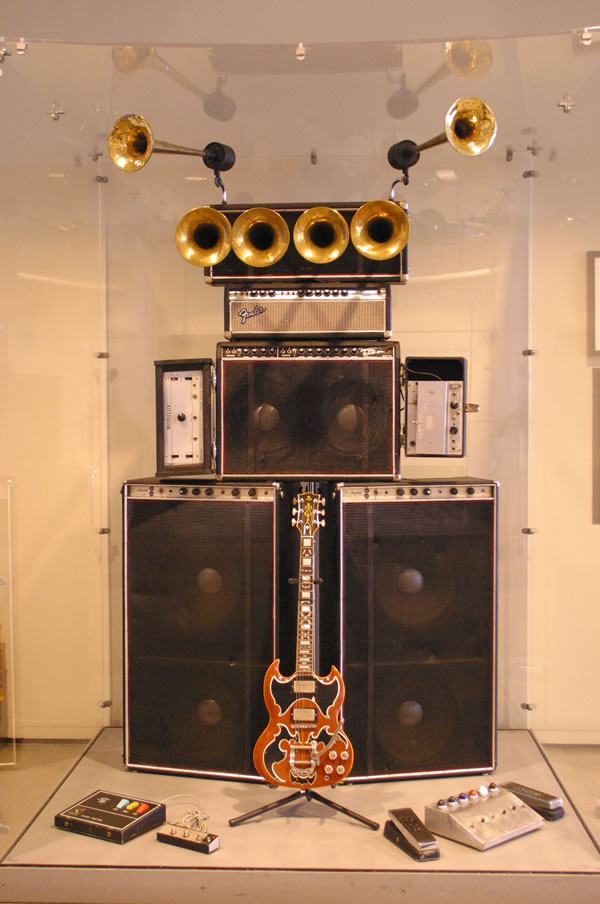
Cipollina's unusual selection and combination of amps resulted in an entirely unique amp stack. On the bottom of the stack sat two solid-state Standel bass amps, each of which were equipped with two 15 inch speakers. In contrast, on the top of the stack sat two Fender tube amps: a Twin Reverb sporting two 12-inch speakers, and a Dual Showman which had been modified to drive six Wurlitzer horns. 

As previously mentioned in chapter one, this set up was deliberately designed so as to form a symbiotic relationship with the guitar. Cipollina's SGs were wired to have one pickup going purely to the Standel bass amps, and have the other pickup going purely to the Fender guitar amps. This meant Cipollina could play with the low crunch of the Standel amps and the classic spiky cleans of the Fenders simultaneously. 

"I like the rapid punch of solid-state for the bottom, and the rodent-gnawing distortion of the tubes on top" - John Cipollina

Lastly, Cipollina also used the driven Wurlitzer horns to good effect, using a foot-switch to turn them on and off. When pushed by the Dual Showman, they provided a familiar rounded tone with overtones of distorted tube breakup (An example of the horn tone can be heard in Quicksilver Messenger Service's 'How You Love').

Effects: Moving onto the last element of Cipollina's famously extraordinary rig, we come to his effects. Although much of Cipollina's sound was provided courtesy of his eclectic amp selection, some of his tone was derived from effects pedals and units.

Most notably, Cipollina's Twin Reverb sported two tape echo machines, one fixed to either side. On the left clung a Standel Modulux, and in similar fashion, so did a Astro Echoplex on the right (scroll down to bottom for image of stack). Like the horns, operation of these was controlled by foot-switch. Quicksilver Messenger Service's 'Mona' provides a perfect example of these echo machines in use. 

Alongside these units, Cipollina also used several Vox wah pedals, which he often used to modulate his guitar signal when using his tape-echo's (once again, hear 'Mona'). For a fuzz, a Gibson Maestro was used (the same pedal used by The Rolling Stones on 'Satisfaction' and by The Doors on 'Hello, I Love You'). Volume pedals were also used when a song called for less distortion for example. 

Saturday, 25 October 2014

The Social End Products Interview with Sta Stea!

Tired of sampling your rock and roll only from the American school of musical psychedelia? Well, threat no more as we take a journey into the mind of Athens-based  quintet, The Social End Products. Drawing from the golden era of European psychedelia, the group captures all the pop rock spook-psych charm of the generation, but modernises it into a fresh, Greek package. - Interview conducted by Daniel Sharman.

Dan: Hi Sta, would you like to introduce yourself?

Sta: I'm the drummer and lead vocalist of the band. I also write the lyrics and some of the music.

Dan: Who else is in the band, and where is the band situated?

Sta: Manos plays guitar and performs vocals, Sara performs guitar/organ/vocals, Themos performs bass/vocals, and Myrto plays flute.


Dan: The band name 'Social End Products' is a very poignant name, where does it originate from?

Sta: We took our name from the title of the song of the same name by New Zealand's THE BLUESTARS. It represents us!

Dan: You guys have a sound reminiscent of the old, European psych groups of the sixties. What are some of your influences?

Sta: I would say we are more influenced from the American bands of the 60s and even more from the South American ones like Aguaturbia, Laghonia, etc. and also very much from sixties Greek bands like Peloma Bokiou, Nostradamos, etc. I feel those influences are more obvious to our new recordings.


Dan: On the band's facebook page, many interesting pieces of vintage gear can be seen. What guitars where you using on your latest sonic outing, Nutre Tu Cabeza?

Sta: Yes we love vintage instruments and when we find something interesting (and cheap) we buy it! Unfortunately, when we were recording our LP didn't have all that so we used a Fender Jaguar and a Fender Jazzmaster. But, on our new recordings we used our EKO guitar collection! 12-string Cobra, Auriga and Melody.


Dan: And how about amps, and effects?

Sta: We have a Fender Twin Reverb and an EKO Herald IV. We use a lot of effects, but think the most interesting is our sixties EKO Multitone.

From left to right: (top) Twin Reverb, EKO Cobra,
Fender Jaguar. (bottom) EKO Auriga. 

Dan: What about any other instruments, such as keyboards, drums, ect.?

Sta: We also use a 70s EKO Tiger Junior Organ.

Dan: Where did you record the latest album?

Sta: We do all our recording's at FEEDBACK SOUND STUDIO in Athens. It is the best for a vintage sound and our producer Harris Zourelidis is a true master of sound!!!


Dan: What have you learnt from Nutre Tu Cabeza's completion?

Sta: It's been very nice in the studio and tripping in the world of sound. Especially when you want to reproduce a sound of the past, you get to have a journey through time.


Dan: What's next for the Social end products?

Sta: We are recording new songs now. Two of them 'FEELS MUCH BETTER ON THE OTHER SIDE' and 'UTOPIA' will be on a 7". That will be out next month on Garden Of Dreams Records, the coolest label in Greece right now. The rest will be in a full LP, which is coming some time in spring. We also have some gigs this month with TOMORROWS TULIPS in Athens and with ALLAH-LAS in Thessaloniki.


Dan: Lastly, are there any shout-outs you would like to make?

Sta: We would like to thank everyone supporting us worldwide. 

Do You Even Psychedelic? would like to thank the band for taking the time to complete this interview.

Find the band's latest LP, and their past 7", here.

You can hear the single from the band's upcoming 7", Utopia, here.

Make sure to keep up to date with their Facebook page here.


Friday, 17 October 2014

The Dead-End Alley Band Interview with Sebastian Sanchez-Botta and Javier Kou!

43 years ago listeners from across the globe took the needle off of their copies of L.A Woman, left with nothing but the harrowing vocal refrain of Jim Morrison singing 'Riders on the Storm'. Over four decades later, Peru-based psychedelists, The Dead-End Alley Band, are bringing it all back. Taking inspiration from the past, this group are creating some of the most authentic-sounding blues-based, stoner rock to come out of the South American continent in recent times. Enjoy the latest instalment in our continuing series of interviews out of Lima, Peru. (read instalments one + two). - Interview conducted by Daniel Sharman. 

Dan: Who is in the band, and who plays what?

Sebastian: Hi, Daniel. Well, this psychedelic adventure started with Javier Kou, playing guitars, bass and some vocal, and me, Sebastian Sanchez-Botta, playing vocals, organs, piano and some drums. Then, on the road, we added a couple of friends to perform live. They are Leonardo Alva on lead guitars, and Jaime Diaz on drums, so, the final line up is: Me on vocals and organs, Javier on vocals and bass, Leonardo on guitars, and Jaime on drums.

Dan: Where does the name The Dead-End Alley Band originate from?

Javier: Besides psychedelic music, I like some other genres and bands, so the name came up a long time ago between 2006 and 2007 when I was listening to Enrique Bunbury’s new album (in that time) in collaboration with another Spanish singer named Nacho Vegas. One of the songs of the album was ‘Welcome to El Callejón sin Salida’ and I liked the part of ‘Callejón sin Salida’ that in English is ‘Dead-End Alley’, so I just put the ‘The’ at the beginning and the ‘Band’ at the end and that was it: The Dead-End Alley Band. I saved that name for some years till I told Sebastian to start this project.


Dan: Some of the Dead-End Alley Band's songs are very organ-focused, not all too common in the often guitar-dominated world of neo psychedelia. What caused you to bring organ into the mix?

Sebastian: It’s because, our first influence to start making psychedelia were ‘The Doors’. Their music had a lot of Ray Manzarek’s organs presence, so we started loving that kind of mix between laced-cheesy-obscured organs with some delayed and fuzzy blues guitars.

Javier: Yeah, and also, in my opinion, the organ plays such a big role in the music we create, is like the nexus between the real world and the trip we offer.

Dan: Your sound contains a wide variety of band's, such as The Doors, The Deltones, Country Joe and The Fish, etc. What are some of your influences, and current favourite bands?

Javier: For the band, some other influences besides the ones you already mentioned are ‘Iron Butterfly’, ‘Phantom’s Divine Comedy’ and maybe some of ‘Vanilla Fudge’. Also when I have to create bass lines some of the influences are from Deep Purple’s Roger Glover and Black Sabbath’s Geezer Buttler. And talking about favourite bands, if I have to name 5 I would say: ‘The Doors’, ‘Alice in Chains’ (the old one without the new vocalist), ‘Alice Cooper’, ‘Héroes del Silencio’, and ‘Judas Priest’.

Sebastian: And for me, my personal influences in organs comes, besides Ray Manzarek, from classical music, some goth organs from Tim Burton’s movies, for example, or some sixties horror b-movies.


Dan: I notice that Javier Kou plays both guitar and bass on the records, how does this work in a live context?

Javier: Like Sebastian said, we had to add some people to play live, so, I play bass at the concerts, because Leonardo is so much better guitarist that I am.

Dan: Why was Leonardo Alva brought into play lead on the track 'The Cosmic Cry Out'?

Sebastian: When we included Leo in the band, we found that he is a blues man. He had a very sweet and sexy “hendrixian” way to seduce with his guitar. ‘The Cosmic Cry Out’ it supposed to be a very sensual track, so… the man with sensual bluesy solos must be there.


Dan: I feel like I'm interviewing a tonne of bands from Lima recently! First Montibus Communitas, then Spatial Moods, and now you guys! How do you feel about the Lima musical scene?

Sebastian: I have a personal feeling about Peruvian’s rock and music as well. I think that the most representative sound of Peruvian rock is the psychedelia from Traffic Sound, Laghonia, Los York’s, etc. Then, combined with the popular ‘chicha’ (psychedelic cumbia), it seems to be that psychedelic sounds are representative from this country. Is not weird, at the end of the day, to find out that we are living in a psych rock camp. A lot of bands here love having a psych sound in their style, and finally you realize that psychedelia is good looking outside, but in Lima, it lives in a very underground world.

Dan: What guitars were used on the Odd Stories recording sessions?

Javier: I like the question, man! Hahaha, Ok!, we used 3 different guitars, a Thomas guitar (A vintage Japanese copy of a Mosrite guitar), an Ephiphone Hollow Casino and 1968 Univox, provided by our friend, brother and co-producer, Chino Burga (from La Ira de Dios).


Dan: Also, what organs/keyboards were used on the album?

Sebastian: Since we started playing and recording, I play with a Farfisa Fast 5 organ, from 1969.

Dan: How about amps and effects (for both organ and guitars)?

Javier: Vox pathfinder and Marshall.


Dan: In a more general sense, what were the Odd Stories recording sessions like? Why did you decide to overdub the sound of rain onto tracks like 'Blue at a distance'?

Sebastian: We used to record in our home studio. Also, we record some tracks in some friend’s houses or studios. For example, drums were edited and mixed at Jaime Diaz studio. ‘Blue At Distance’ is a track with some feelings of loneliness. The story of a lonely guy walking through the streets at night, under the rain. We thought the sound of rain could increase that feeling of loneliness we wanted.

Dan: Who created the artwork of Odd Stories? And what does it depict?

Javier: Sebastian came with the whole illustration, and I made the work in photoshop.


Sebastian: It's an "odd story" too, hehe. The first song we composed for this album was Devil's Mask. It was my favorite song, and also, I told Javier to have that song as a single for the album. I thought the album will be called 'Devil's Mask', so I draw this weird guy with a 'diablada' mask, representative from the southern highlands here. When I wrote the lyrics and thought the story of the song, I decided to use that mask, because it's very crazy. It looks very mad and psych, too.


Dan: What's next for The Dead-End Alley Band?

Javier: Actually we are working in some demo's for the 3rd album, I guess we have the songs we want to record in a close future, but I would like to have more songs so we can choose some of them and save the others for b-sides or compilations with other bands. That’s all I can say about.

Dan: Is their anything else you would like to say or any shout-outs you would like to make?

Javier: Hmm, not really, we are preparing the official release of the LP here in Lima, also some labels here are working now on the CD and Tape editions of the ‘Odd Stories’ so it will be a complete album release, a big party (or slaughter… hehehe)! Also we would like to thank to all the people who have been supporting us since the beginning, I won’t say names ‘cuz it may take too long, and thank you for the interview and the time.

Sebastian: Just hit “play” and let yourself get carried away by a night of pure madness!!

Check out the fantastic new Dead-End Alley Band record, Odd Stories, here. 

Also, make sure to like the band's Facebook page to keep up to date, here.